Ticks are one of those walking hazards that are easy to forget until you find one. They are small, they do not announce themselves, and a dog’s coat is very good at hiding them. The answer is not to avoid the outdoors. It is a short, predictable check at the end of the walk, done the same way every time, so it becomes as ordinary as wiping paws or refilling the water bowl.
This is general guidance, not veterinary advice. Your vet knows your dog and your region, and is the right person for questions about prevention and health.
Know when and where the risk rises
Ticks live in vegetation and wait for a passing host. They are most associated with long grass, scrub, woodland edges, hedgerows and deep leaf litter, which is why a woodland trail or an overgrown field carries more risk than a clean pavement loop.
Seasonality varies by region, and ticks can be active across much of the year when conditions are mild, so it is safer not to assume a season is tick-free. Your vet or local animal health sources can tell you what is typical where you live. As a rule, if your walk went through anything your dog brushed against with its legs, belly or face, it is worth checking.
Dogs that like to put their noses into undergrowth, which is most of them, pick up ticks in exactly the places you would expect: head, neck and front legs first.
Check promptly, and make it a routine
The sensible habit is to check soon after you get home, before your dog settles into the sofa. A tick that has only just climbed on is easier to find and remove than one that has had time to settle and feed.
Keep it calm. Ten minutes of fussing turns the check into something your dog avoids; two minutes of slow, gentle handling turns it into a quiet moment of attention. Praise, a treat, or a short stroke between sections all help.
Good light and a comfortable surface make the job easier. Many owners do it standing at the door or with the dog lying on a towel.
The two-minute routine
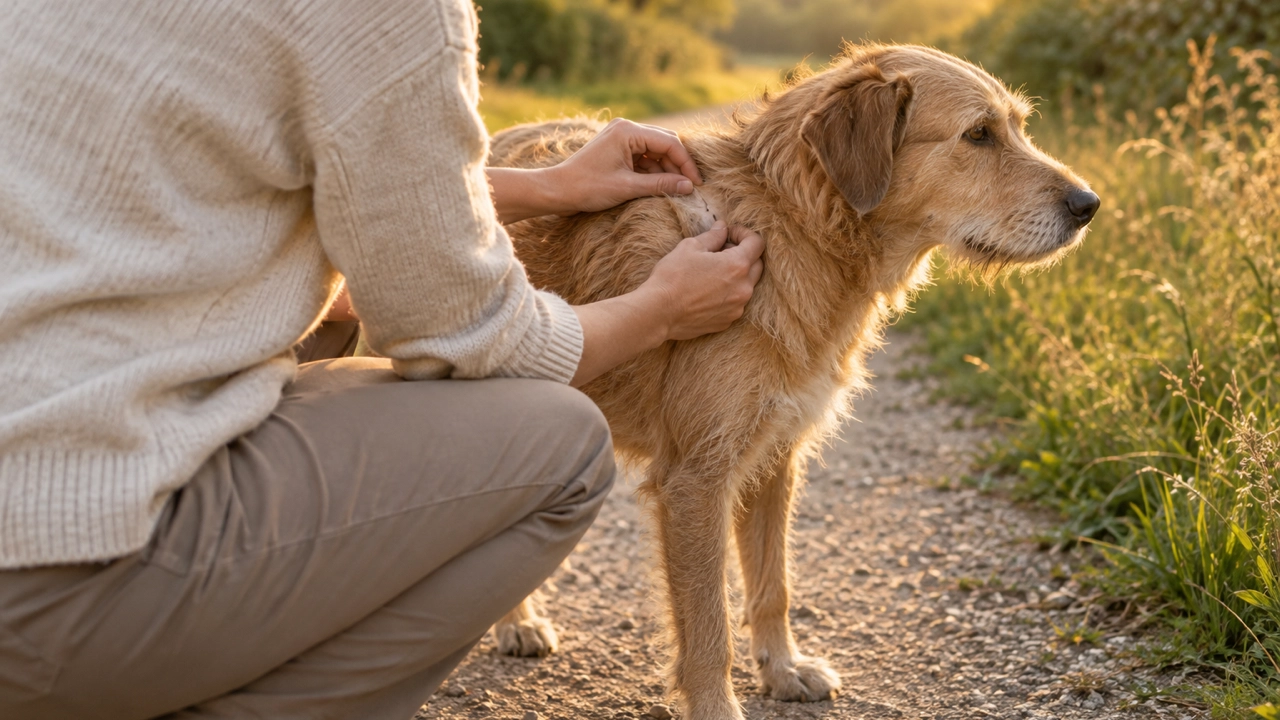
Work with the flats of your fingertips rather than looking only with your eyes. Ticks are often easier to feel than to see: a small, firm bump on otherwise smooth skin. Part the coat as you go so you can see the skin underneath.
- Head and ears. Check the base and inside of each ear, around the eyes, along the muzzle and under the chin.
- Neck and collar line. Slide a finger under the collar or harness straps and feel all the way round. These areas can hide something against the skin.
- Chest and front legs. Include the armpits, where skin is thin and the coat is sparse.
- Between the toes and around the paws. Gently spread the toes and look at the skin between them. If you already do a paw check, this is the natural time for it; our guide to cleaning your dog’s paws after a walk covers the routine.
- Belly and groin. Roll your dog gently onto one side if they are happy to be handled and check the underside, the inner thighs and the groin.
- Back, tail and under the tail. Run your fingers along the spine, check the base of the tail and lift it to look underneath.
Dogs with dense, curly or long coats need a slower pass. A fine-toothed comb can help you lift the coat and see the skin, and you may find it easier to work in sections.
What a tick looks like
An unfed tick can be very small, so it can look like a speck of dirt at first. A tick that has been feeding for a while swells noticeably and can look grey, tan or dark, like a small round bean attached to the skin. You may also notice a small red patch on the skin where it has attached.
If you are unsure whether something is a tick, a scab or a skin tag, look closely. A tick is firmly attached and may show tiny legs close to the skin. If you are still not sure, do not pick at it. Ask your vet.
Removing a tick safely
If you find one, stay calm and have the right tool ready: a pair of fine-tipped tweezers, or a purpose-made tick remover from a pharmacy or vet. Wear disposable gloves if you have them, and wash your hands afterwards.
- Hold your dog still and part the fur so you can see the tick clearly.
- Grip the tick as close to the skin as you can, taking care not to squeeze its body.
- Pull steadily and straight out, with even pressure. Avoid sudden jerks or heavy twisting.
- Clean the area and your hands afterwards.
Do not use petroleum jelly, alcohol, a lit match or any other home remedy to try to make the tick let go. These do not work reliably and can make things worse.
If the head or mouthparts seem to stay in the skin, do not dig around. Leave the area clean and call your vet for advice. Some owners keep the tick in a sealed container, or take a clear photo, in case the vet wants to see it. Ask your vet whether this is useful for you.
Watch the area, and your dog
After removal, the spot may look a little red or slightly raised for a short time. Keep an eye on it over the following days and on how your dog is behaving.
Contact your vet if the area looks increasingly red, swollen or sore, if you are not sure the whole tick came out, or if your dog seems unwell in the days or weeks afterwards. Signs to mention include unusual tiredness, a poor appetite, a raised temperature, stiffness or limping that does not fit with the walk. A bite does not always mean illness, but ticks can carry disease, so if something feels off, a phone call is better than waiting. You do not need to diagnose anything yourself.
Prevention is a conversation with your vet
Checks are one layer. Prevention is another, and the right answer depends on where you live, how you walk and your dog’s health, age and weight. Many vets offer tick prevention in several forms, and some products suit some dogs better than others. Because products vary and some are unsuitable for certain dogs or households, ask your vet which one fits yours rather than choosing from a shelf.
Some practical habits that sit alongside prevention:
- Keep to the centre of paths where you can, particularly in warm, wet weather.
- Keep your dog out of dense undergrowth and leaf litter on high-risk routes.
- Check yourself too. If your dog picked one up, you may have as well.
- Brush or comb the coat after woodland and meadow walks.
- Wash bedding and the places your dog rests on a regular basis.
If you are heading somewhere new, our first hike with a dog checklist gathers the basics worth packing and planning for, and the same thinking applies to a camping trip with your dog, where the time spent in long grass and woodland goes up.
Make it a habit, not a worry
A tick check works best when it is boring. Same door, same order, same two minutes, every time you have been somewhere grassy or wooded. It should be unremarkable, and it will mean that on the rare day you do find a tick, you find it early and know exactly what to do.
If you want to start small, pick one part of the routine, perhaps ears, neck and chest, and build from there. Consistency matters more than perfection.