The first dark walk of autumn can feel unexpectedly different. The familiar pavement has deeper shadows. Cyclists appear later. Your dog notices a rustle in the hedge before you can see what caused it.
Walking a dog at night safely is less about buying one bright accessory and more about making a few considered changes. You need to be visible. You need to see the ground ahead. Your dog needs enough support to move through a familiar place that now looks, sounds and smells different.
Start adjusting before darkness becomes the new normal. A calm routine is easier to build while there is still a little evening light.
Make both ends of the lead visible
A reflective collar, harness or lead returns light towards its source. It can be highly effective when a vehicle’s headlights, a bicycle lamp or a torch reaches it. But reflection depends on that light arriving at the right angle. If a driver is turning out of a side street, or a cyclist’s lamp is pointed elsewhere, reflective material may not yet be illuminated.
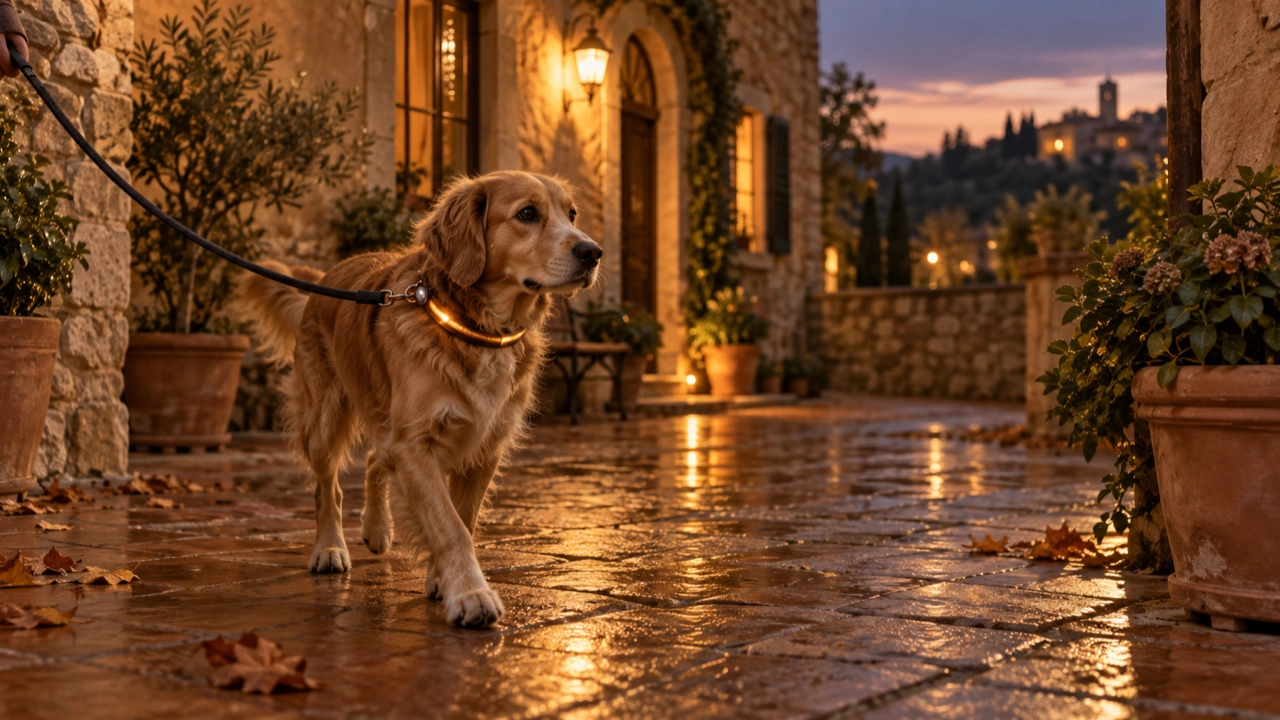
Self-lit gear does a different job. A small steady light or softly illuminated band makes your dog easier to place before an external beam reaches them. Choose a light that is visible without being dazzling, securely attached and suitable for wet weather. Check its charge before leaving. Flashing modes can attract attention, but a steady light is often easier for other people to track and less distracting for the dog wearing it.
Use both approaches if your route includes traffic or unlit sections. Think in layers rather than relying on a single point of light. A reflective detail on the dog, another on the lead or your clothing, and a modest self-lit element make the whole pair easier to understand at a glance.
Visibility matters for the person too. Wear a light or reflective outer layer rather than assuming the dog’s collar will identify you both. Keep coats and bags from covering reflective panels. Dark clothing can disappear against hedges, parked cars and shaded walls long before the street feels fully dark.
Carry a light that helps you see
Being seen and seeing the route are separate tasks. A lit collar marks your dog’s position. It does not reveal a broken paving stone, low branch, discarded food or patch of ice ahead.
Carry a small torch or wear a headlamp with a comfortable, controlled beam. Aim it towards the ground in front of you, not into the eyes of approaching people or dogs. A lower setting is often enough on residential streets and helps preserve your night vision. Increase it for an unlit path, then lower it again near traffic and homes.
A phone torch is useful in an unexpected moment, but it is awkward as the main light while holding a lead, opening a gate or picking up after your dog. A dedicated light leaves your phone available for directions or a call and is easier to operate with gloves.
Before each walk, check the light and your dog’s illuminated gear together. Spare batteries or a small backup light are sensible on longer routes. Simple equipment is most useful when it is ready by the door.
Choose a route for the conditions
The best daytime route is not always the best night route. For darker evenings, favour consistent lighting, even surfaces and clear sightlines. A slightly shorter loop along occupied streets may be more comfortable than a quiet path with blind corners and dense planting.
Look at the route as a connected sequence. A well-lit road can still lead to a dark underpass. A bright park entrance may give way to an unlit boundary path. Notice where lighting ends, where pavements narrow and where you would cross if the usual point felt unsafe.
Walk towards oncoming traffic only where local guidance and the road layout make that appropriate, and use proper pavements and crossings whenever they are available. Do not assume a driver has seen you because you can see the vehicle. Pause, make your position clear and wait for enough space.
If rain makes the ground reflective, glare can hide surface changes and make everyone harder to read. Our guide to walking a reluctant dog in the rain covers how to shorten and simplify an outing when wet weather adds another layer of difficulty.
Keep the connection predictable
Darkness is not the time to give more lead than you can manage. Keep your dog leashed, even on a familiar route, unless you are in a securely enclosed area where dogs are permitted off lead. Wildlife, cats, food scraps and other dogs can be much closer than they first appear.
A fixed lead offers a clear sense of distance. Keep enough slack for natural movement without allowing the line to trail, cross a cycle path or disappear into shadow. Shorten it before a junction, narrow passage or approaching person rather than gathering it at the last second. If you are deciding what works for your route, read how to choose a dog lead length.
Avoid wrapping the lead around your hand. Hold it securely and keep the hand you need for your torch or waste bags organised. If your dog is strong enough to pull you off balance, a qualified reward-based trainer can help with an individual walking plan.
Read the dog in front of you
Dogs often notice movement and sound before we do, but lower light can still change how confidently they interpret the environment. A bin bag may become an unfamiliar shape. A person in a hood may seem to appear from nowhere. Foxes and other wildlife can move through spaces that are quiet during the day.
Watch for a slower pace, repeated scanning, sudden freezing, a tucked tail or an urgent pull towards home. These signs do not need to become a confrontation. Create distance. Let your dog look without forcing an approach. Speak calmly and move on a gentle arc if there is room.
Do not use the lead to drag a worried dog past something they cannot understand. Cross the road, turn down a familiar side street or pause in a brighter place. If your dog can take food comfortably, reward them for checking in with you and moving away calmly. If they cannot settle, shorten the outing.
Dogs with changes in vision, hearing, movement or behaviour may need a more individual routine. If night walks have suddenly become difficult, or your dog seems disoriented or distressed, speak with your veterinarian rather than treating the change as disobedience.
Leave room for other path users
Night reduces the time everyone has to respond. Runners may be wearing headphones. Cyclists can approach quickly. Another dog’s light may be visible before the lead or person attached to it.
Stay to one side of shared paths and avoid looking continuously at your phone. Keep audio low enough to hear a bell, engine or footsteps. When someone approaches, bring your dog to the side furthest from them and make the lead length obvious. A brief greeting is not required. Space is often the more considerate choice.
Wildlife deserves the same margin. Do not allow your dog to investigate animals in hedges or verges. Move away without chasing, shining a bright beam directly at the animal or letting the lead tighten into a prolonged standoff.
Adjust the routine before the clocks change
Move the evening walk a little earlier if you can. Even ten or fifteen minutes may preserve useful light at the start of the route. Try the darker version of a familiar loop before full winter, so you can identify awkward crossings and poorly lit sections without discovering them all at once.
Set up a small evening kit near the lead: charged lights, reflective layer, waste bags and a cloth for damp paws. Check fastenings and batteries regularly. Replace anything that has become dim, loose or difficult to operate.
Cold arrives with the shorter days too. The same evening walk grows icier and grittier underfoot — hazards that are harder to see in low light and affect small, thin-coated, senior and unwell dogs first. walkingdog.io’s guide to winter walking limits and paw care covers the thresholds.
The aim is not to make night feel like day. It is to remove avoidable surprises. With visible layers, a route chosen for the conditions and calm handling at the other end of the lead, a dark evening walk can remain an ordinary and enjoyable part of the day.
Join the Ottimo Plus waitlist for considered dog essentials designed around everyday life together.