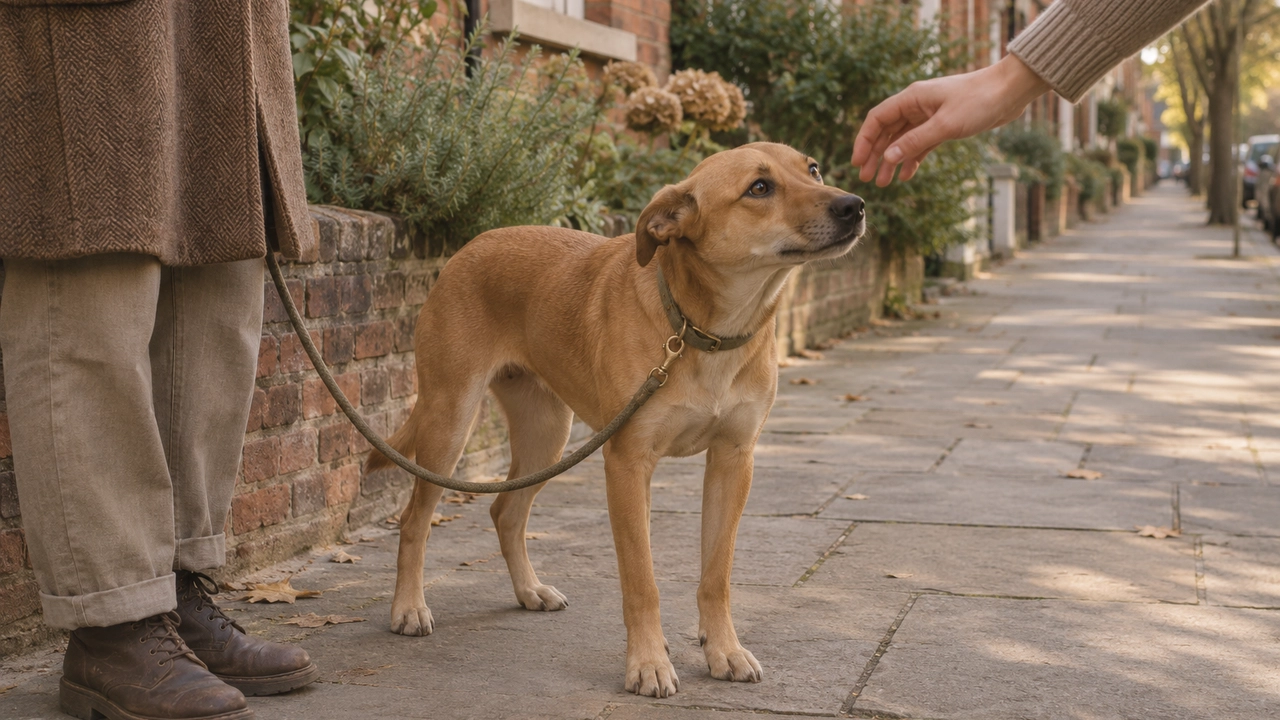
Someone stops in front of you on the pavement, hand already half out. “Is he friendly?” They are not asking about your dog’s character. They are asking whether they may touch him, and they have phrased it so the answer is meant to be yes. You have about two seconds to decide.
This is general guidance for owners, not behavioural or veterinary advice. If your dog shows persistent fear or aggression, ask a qualified behaviourist.
Friendly and available are two different things
Most dogs are friendly. Friendly describes what a dog will do when a stranger appears: hold still, not growl, perhaps wag. Available describes whether he wants a hand on him now.
A dog can be entirely friendly and still not want contact while he is mid-sniff, in a doorway, tired, sore, or done with being handled by strangers.
“He’s friendly” is the sentence that starts the trouble because it answers a question nobody asked. It tells the stranger the decision is made, so the hand keeps coming, and it commits your dog to an interaction he never agreed to. If he turns his head or steps back, he looks like the difficult one. He is being honest, and nobody was listening.
What your dog is actually telling you
Dogs are not silent about this. They are quiet, fast, and the signals live in the body.
Approach. A dog who wants contact offers it: steps towards the person, leans in, sniffs, comes back for more. The approach belongs to the dog.
The head turn. A small turn away, or a glance to the side, is often the first no. Easy to miss because it is polite, and because the person is still talking.
Lip lick and yawn. A quick tongue flick with no food involved, or a yawn at an odd moment, is a dog buying time. It often comes just before the head turn.
Stiffening. The body stops moving. Loose becomes still, and the stillness has a set to it. The clearest of the signals, and the one people walk straight through.
Weight shift. Weight back onto the hind legs, away from the hand. The dog is leaving before his feet do.
Tail set. A fast, high tail is not automatically happy, and a low or clamped one is not an invitation. Read it with the rest of the dog.
Retreat. Stepping back, moving behind your legs, pressing into your calf. A dog who puts you between himself and a stranger has answered for you.
None of this takes training to read. It takes a few seconds of looking at your own dog instead of the person.
Greeting, or tolerating?
A greeting is mutual and short. The dog checks the person, decides, then either stays for more or walks away.
Tolerance looks almost identical and is a different event underneath. The dog holds still, allows the hand, may even lean into it. Then, once the person has gone, he shakes off, licks his nose, or leaves the spot. Nothing bad happened. Nothing was given either.
Tolerance has a limit you cannot see. A dog who has tolerated hand after hand and objects to the next is not unpredictable: he has been signalling all along, and that person arrived after the patience ran out.
What to say, and how to say it
Short, warm, and without an apology. An apology turns a boundary into an offence and invites negotiation.
Keep it under about ten words, and keep walking. A refusal delivered standing still sounds like the opening of a conversation. The same words over your shoulder end it.
- “Not today, but thanks for asking.”
- “He’d rather not. Have a good one.”
- “He’s not up for hands, but you can say hello from there.”
The distance offer is worth keeping: a greeting from a step away costs your dog nothing and usually ends the encounter happily.
What you do not owe anyone is the reason. A rescue history, a sore hip, a fear period: none of it needs explaining on a pavement. People who argue with a no would argue with a reason.
Children, and the hands that arrive first
Children move quickly, at face height, with fingers spread. Do not wait to see how your dog handles it.
Put your body in the way first. Step between, shorten the lead, turn your shoulder into the gap. Then speak to the child, not over their head: “He doesn’t want to be touched today. You can help by walking past quietly.” That gives a child a job instead of a telling-off.
If an adult is with them, say the same line to the adult and keep moving. Be brief. A long explanation makes your dog a spectacle, and a spectacle attracts more hands.
When the hand is already out
Do not grab for your dog’s collar and do not raise your voice. Both add noise to a moment that needs less.
Step across so your body arrives before the hand does, gather the lead, use the line. If the touch has landed and your dog is relaxed, let it pass and end the encounter anyway. If he has stiffened, give the space back and leave. He does not need telling off for a warning, or praise for enduring.
Leads, queues, and tight spaces
A lead is a message, and not everyone reads it: approach with care, no signal at all, or a challenge, which is their problem.
The encounters you cannot walk out of are the ones that go wrong: a queue, a café, a lift, a doorway. There, arrange the geometry before the hand arrives. Dog on the far side of your body, away from the queue, your leg between him and the person behind you, your face towards where you are going. A dog with his back to a wall has nowhere to retreat.
A shorter lead in a crowd is not a shorter walk. It lets you gather him in one movement instead of three. Our guide to how long a dog lead should be covers where that length belongs.
A dog park has conventions, and our piece on the unwritten rules of the dog park covers those. A pavement has none, only you deciding for a dog who cannot say it out loud.
Some dogs need distance, and that is not a defect
Rescues with an uncertain history, dogs in pain, adolescents in a fear period, older dogs with less patience: all can be fine in the world and not fine with hands.
This does not need fixing before you go outside. It needs managing, and managing is mostly geometry: cross the road before the greeting rather than during it, pick the quieter hour, take the wide side of the pavement.
None of that is avoidance. It is the logic behind any sound everyday walking routine: predictable, low-pressure repetition, in places where the dog knows the shape of the day. A nervous dog learns more from repeated uneventful walks than from one brave encounter.
After a bad interaction
If your dog snapped, or a stranger was frightened, leave first and assess second. Put distance between them, then look at your dog properly: is he shaken, is he lame, is he fine? Check the person was not hurt; if there is any doubt, exchange details and be straightforward.
Then look at what came before the snap, because that is where the information is. Was he cornered? Was someone bent over him? Had he been on a short lead in a doorway for ten minutes?
Do not punish the growl. A dog corrected for warning usually gives less warning next time, not more. And do not decide your dog is reactive on the strength of one moment. He has drawn a line, not changed personality. If it happens again, talk to a qualified behaviourist.
The decision is yours, and it is small
You are not obliged to hand your dog over to anyone who asks nicely. The stranger’s disappointment lasts a few seconds. The dog carries the consequence for longer.
So say the line, keep walking, and let the dog decide. It is not unfriendly. It is the cheapest kindness available on a pavement, and the only one that is yours to give.