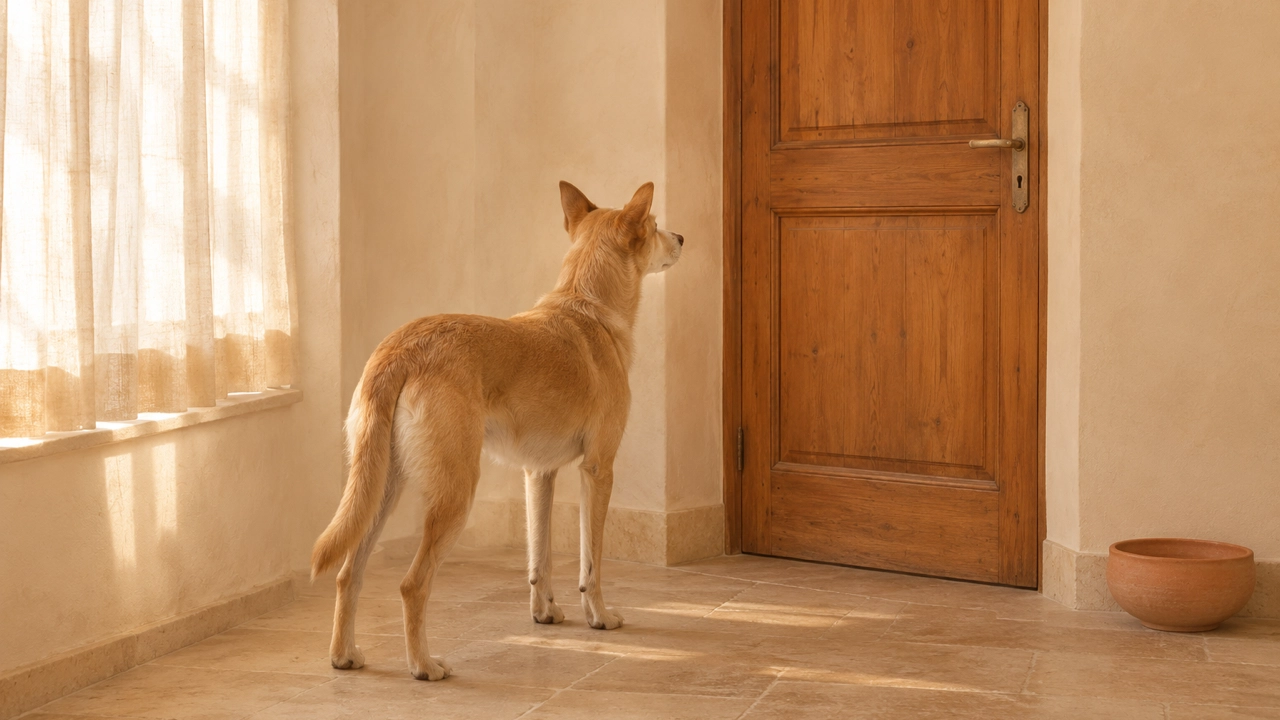
The courier rings once. By the time you reach the hall, your dog is already at the door, barking at a panel of wood. You open it, apologise, sign, and he barks again at the van pulling away.
By late November it is happening several times a week. In December, most days. Each delivery is a rehearsal, and it is a rehearsal your dog keeps winning.
The bell is not frightening, it is promising
Owners usually describe the reaction as fear, and treat it the way they would treat fireworks: soften the sound, close the curtains, comfort the dog. That advice assumes the dog is scared. Watch the body before you accept the label.
A frightened dog retreats. He lowers his head, tucks his tail, backs away from the door and looks for an exit. The dog who charges the door with his tail up, his ears forward and his weight over his front feet is not frightened. He is early. He knows what the bell means and he wants to be first at it.
That distinction decides the fix. Fear needs distance and a slow, gentle approach. Anticipation needs a job.
Why the barking keeps working
Bell, bark, door, person, parcel. The sequence pays out almost every time, and even the shouting pays something: a dog told off at the door still got the door.
So the behaviour is not random, and it is not disobedience. It is a habit built on results, practised several times a week in the busiest month of the year. Telling a dog to stop asks him to give up a strategy that has never failed him.
Give the bell a different meaning
The aim is not a dog who never notices the door. It is to put one behaviour between the bell and the threshold, so the bell predicts a place to go rather than a race.
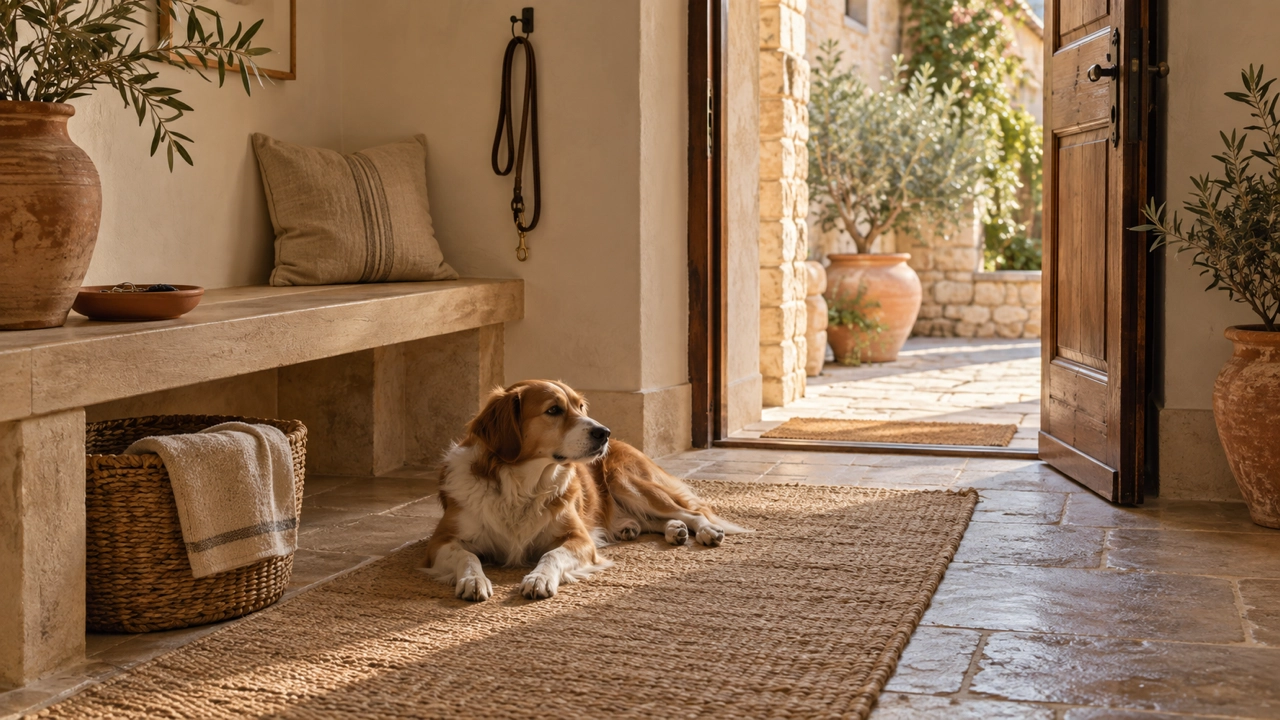
Choose a mat or a bed near the front door but out of the direct line to it, two or three paces back, where the dog can still see the door open. Then teach him that the mat is worth standing on. This is the settle you would build for a café or a waiting room, and our guide to teaching a dog to settle at a café covers the groundwork in detail.
Keep it simple at home. Reward any interest in the mat, then standing on it, then lying down. Feed low, between the front paws, so the food does not pull him off the spot. Name the mat, and add a release word so the exercise has a clear end. Thirty seconds is plenty at this stage.
One caution: a mat that appears only when something dramatic happens at the door will not read as a good place. Leave it down. Let him sleep on it.
Rehearse with a recording
Do not start with a person. Start with the sound.
Record your own doorbell on a phone and play it at a volume low enough that your dog lifts his head and nothing more. Ask for the mat, reward, stop. Two repetitions, then finish.
Over the next week, raise the volume in small steps and vary the timing. A dog who only responds at seven in the evening has learned your schedule, not the bell. Add the noises that arrive with a delivery: a knock, the letterbox, a sliding van door, footsteps on the path.
If he leaves the mat and barks at the speaker, the volume was too high. Drop it back and end on an easy repetition.
Then someone real
Ask a friend for twenty minutes. The sequence is the one you have already practised: the bell, the mat, the reward, and only then the door.
The friend should not greet the dog with a hand out and a high voice. A quiet hello from a step back is plenty. Talk for a minute, close the door, release the dog and pay him while he is still lying down.
Run it twice, then again on another day with a different person. Change one thing at a time: the friend, the hour, whether the door opens at all.
If he breaks position and arrives at the door, close it and start again. The door is the most valuable thing in the house. It should not open for barking. The rule is easy to write and hard to hold with a stranger in the rain, which is why the next section matters more than perfect timing.
The courier, and the days you are upstairs
Real deliveries do not wait for you to be ready.
Keep the reward by the door. A small jar on the hall shelf, on the mat side, out of reach. The routine has to run in one movement when the bell goes.
Answer at a normal pace, and use the geometry. The parcel will still be there; hurrying is the dog’s cue, not the courier’s. Body between dog and doorway, hand on the door, one foot back. If he is on the mat, he is already behind you.
Put a second door in the plan. A stair gate, or a closed internal door between hall and house, lets you open the front door without managing both ends of the room. This is the version that survives a bad week. It is management, not training, and management is allowed.
Let the drop be a drop. If your dog cannot settle and the caller is a courier, ask for the parcel to be left. You do not owe a stranger access to a hallway with an excited dog in it.
Make December quieter at the door
The simplest fix for December is fewer rehearsals. If your doorbell can sound a phone notification instead of a chime, use that setting. Your dog still gets deliveries. He stops getting repetitions.
A note on the door asking for parcels to be left without knocking costs nothing. Moving the dog to another room for the delivery hour, with something to chew, does the same job. None of this is avoidance. It is the same logic as walking a nervous dog at a quiet hour.
There is also the rest of the day to consider. A dog who has been out, sniffed properly and come home tired has less to spend on a bell. No substitute for the mat, but a settled everyday walking routine takes some of the charge out of an indoor day.
What does not work
Shouting at the door gives the dog company and confirms the door is worth shouting at. Ringing the bell fifty times to get him used to it is flooding, not training: an overwhelmed dog learns that the bell is relentless. A “quiet” cue taught while he is already barking asks for something he cannot yet do. And leaving him to bark it out does not work, because the door still opens in the end.
When it is something else
Most doorbell barking is anticipation with a poor outlet. Some of it is not.
A dog who guards the door, who stiffens when you approach the handle or growls when you reach past him, is not overexcited. That needs a qualified behaviourist, not a mat.
A dog who retreats, trembles, hides or urinates at a knock is frightened rather than eager, and the plan should look closer to our guide to calming a dog during fireworks, which is about noise fear rather than excitement.
If a usually steady dog starts reacting after years of ignoring the door, a vet check is sensible, particularly for an older dog whose hearing or eyesight has changed. Pain alters behaviour more than owners expect.
If the barking has escalated to lunging or snapping at visitors, or happens mainly when your dog is alone, stop improvising. Ask your vet and a qualified reward-based behaviourist. This article is general guidance, not veterinary or behavioural advice.
A quieter hallway
Your dog is not defending the house from the postman. He is doing the thing that has always worked, in a month when it works several times a day.
Give the bell a different ending. It will still ring on Tuesday. What changes is the four seconds after it, and the dog who already has somewhere to go when it does.