A dog-friendly café is not automatically a dog-friendly experience. Chairs scrape, cups arrive at nose height, strangers pass close by and another dog may appear without warning. For a dog who has only learned to relax at home, the request to lie quietly beneath a table can be surprisingly difficult.
Settling is a skill, not a personality type. It can be taught in small steps. The goal is not a dog who never looks up. It is a dog who can notice ordinary café life, return to rest and trust that you will manage the space around them.
Decide whether a café suits your dog
Not every dog enjoys busy social places. Age, health, temperament and past experience all matter. A sociable dog may still dislike confined spaces. A calm dog at home may become watchful when people approach from several directions.
Before planning a visit, look at how your dog handles quieter public settings. Can they take food gently, respond to familiar cues and recover after a cyclist, trolley or another dog passes? Can they lie down for a few minutes without repeatedly scanning the environment?
If your dog trembles, hides, lunges, barks continuously or tries to escape, a café is too demanding for now. More exposure is not always the answer. Create distance, return to an easier setting and consider guidance from a qualified reward-based trainer or veterinary behaviour professional if the reaction is intense.
Build the behaviour at home
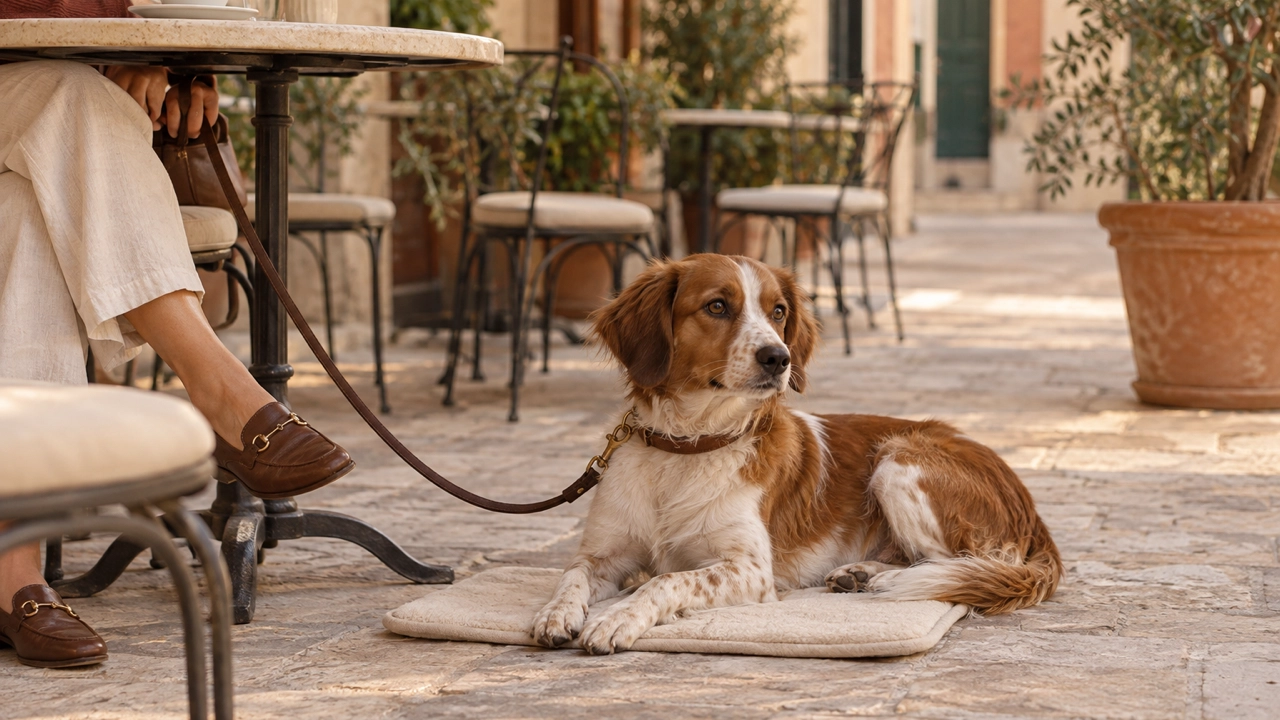
Start with a portable mat or small blanket on the floor. It should be large enough for your dog to lie on but compact enough to fit beneath a table. Let your dog investigate it. Reward any calm interest: stepping onto it, standing still, sitting or lying down.
Once your dog chooses the mat readily, reward the moments that look like settling rather than constant activity. A hip rolled to one side, a lowered head or a slower breath are useful signs. Place the reward calmly between the front paws so the delivery itself does not pull the dog back into excitement.
Keep early sessions short. Thirty quiet seconds can be a better foundation than ten restless minutes. Add a release word before your dog gets up, then invite them away from the mat. This makes the beginning and end of the exercise clear.
You do not need to repeat a verbal cue throughout the session. Say it once if you use one, then allow the mat and the routine to carry more of the meaning.
Add ordinary distractions gradually
A silent living room is not much like a café. Once the basic behaviour is comfortable, introduce one small distraction at a time. Sit in a chair. Move your feet. Place a cup on the table. Stand up, sit down and walk past the mat. Reward your dog for staying relaxed, but make each change easy enough to succeed.
Then practise in other familiar places: the kitchen, a hallway, a friend’s garden or a quiet bench outside. The mat may be the same, but the surrounding picture changes. Dogs do not always assume that a skill learned in one room applies everywhere.
If your dog repeatedly gets up, shorten the exercise or reduce the distraction. This is information, not failure. Training progresses more cleanly when the next step is only slightly harder than the last.
Choose the first café carefully
The easiest first visit is rarely Saturday brunch. Choose an off-peak time, good weather and a place with generous spacing. An outdoor table at the edge of a terrace is often simpler than a narrow route beside the counter.
Check the venue’s dog policy before you go. “Dog-friendly” can mean dogs are welcome only outdoors, only in one section or only under specific conditions. Staff should not have to reorganise the room after you arrive.
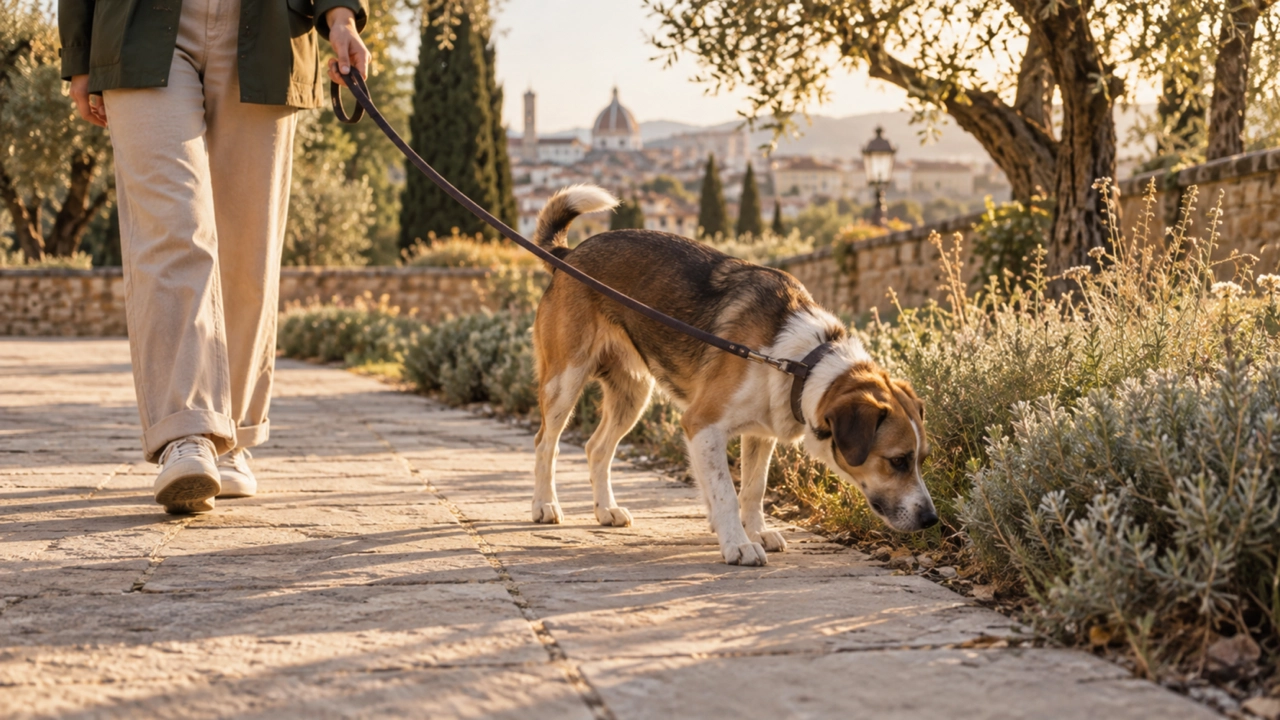
Walk your dog beforehand, but do not try to exhaust them. A calm sniffing walk and a chance to toilet are more useful than intense exercise that leaves them thirsty or overstimulated. If your dog tends to pause and investigate every scent, our guide to why dogs stop and sniff on walks can help you plan a quieter approach.
Bring the familiar mat, water, a few small rewards and waste bags. Use a secure, well-fitted harness or collar and a standard lead. Retractable leads create unnecessary movement around chair legs and passing feet.
Arrange the table for calm
Position the mat where your dog is protected from foot traffic but still visible to you. Under the table or beside a wall can work well. Keep the lead short enough that your dog cannot reach neighbouring tables, yet loose enough for a comfortable change of position. Never attach the lead to light furniture that could move if the dog startles.
Sit between your dog and the busiest part of the space when possible. This small piece of body blocking reduces the number of interactions your dog has to manage. Ask people not to greet them while they are settling, even if your dog is normally friendly.
Food from the table should remain off limits. It is safer for the dog and kinder to the next customer. If you offer a chew, choose one you already know your dog handles calmly and that will not create a mess or tension around other dogs.
Keep the first visit deliberately short
Order something simple and be prepared to leave. The first successful visit might last ten minutes. Reward a few calm choices, allow your dog to look around and finish while their body is still loose and their attention can return to you.
Watch for early signs that the environment is becoming difficult: persistent panting when it is not hot, repeated lip licking, pacing, whining, a tucked tail, refusal of familiar food or an inability to lie down. One sign in isolation does not tell the whole story, but a pattern means the visit should end.
Leaving early protects the training. Staying until the dog barks, lunges or shuts down only rehearses the part you did not want.
Progress by changing one thing at a time
On later visits, extend either the duration or the difficulty, not both. Stay five minutes longer at the same quiet venue, or visit a slightly livelier terrace for the same short period. Keep enough easy repetitions between challenges that the mat continues to predict rest.
Real life will interrupt the plan. A dropped tray, an approaching child or a dog beneath the next table may require you to stand up and create space. Calm handling matters more than proving your dog can remain in place. Move first, settle again only if the environment becomes manageable, and leave if it does not.
Make café time optional
A dog does not need to accompany every social plan. Some dogs become excellent café companions; others are happier resting at home or walking with you before you meet friends. Both are good outcomes.
Success is not measured by how long your dog stays beneath a table. It is the ability to rest without being trapped there, and your willingness to notice when the situation is no longer comfortable. Practise the skill slowly, choose the setting thoughtfully and keep the first outings brief. The relaxed afternoon comes from all the uneventful preparation before it.
Join the Ottimo Plus waitlist for considered dog gear designed around everyday life together.