A cooling vest looks like a tidy answer to a hot-weather problem. Wet it, fit it, walk. The pitch is that your dog stays cooler without you changing anything else.
Do dog cooling vests work? In the right conditions, they can help. In the wrong ones, they do very little, and some can make things worse. The difference comes down to how the vest cools, what the air around your dog is doing, and whether the vest fits well enough to do its job without getting in the way.
How evaporative vests work
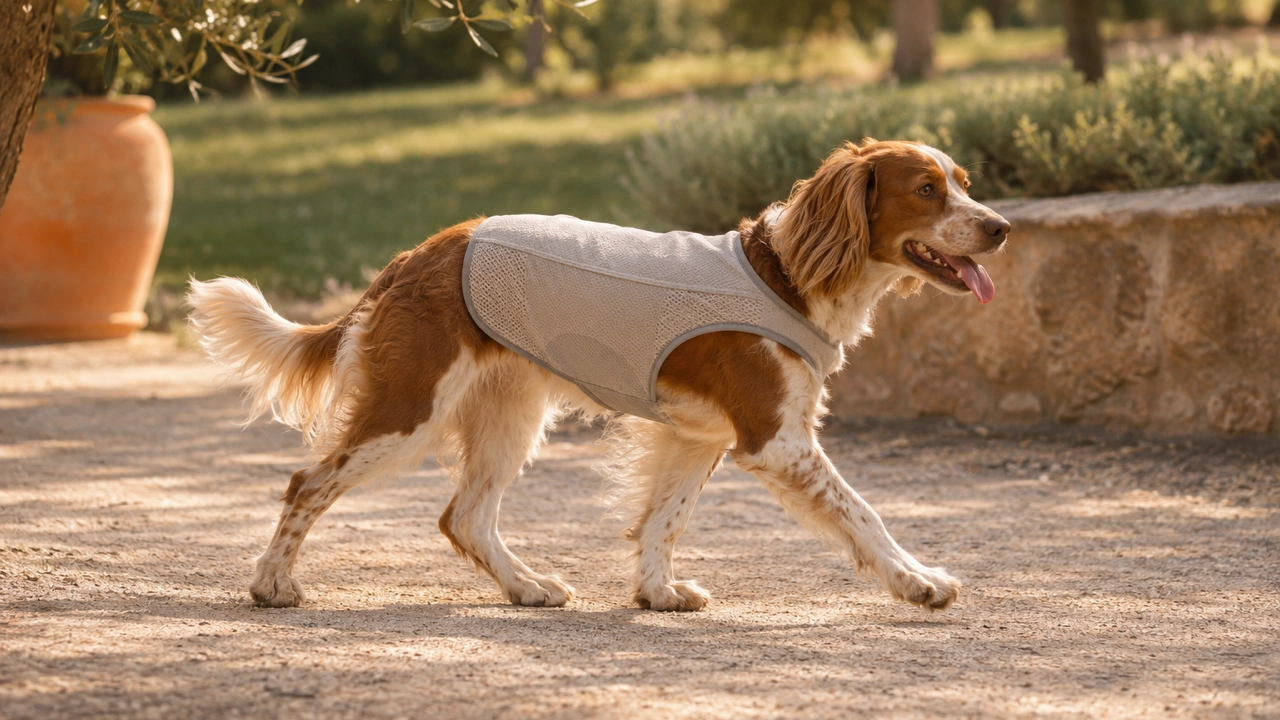
Most cooling vests are built from layered fabric that you soak in water, wring out and put on your dog. The cooling comes from evaporation. As water leaves the fabric as vapour, it takes heat with it. That is the same principle that makes a damp cloth feel cool on your neck on a dry, breezy day.
Two things have to be true for it to work. The air has to be able to take up more moisture, which means low humidity. And air has to move across the fabric, which means a breeze or a walking pace. Take either away and evaporation slows.
This is the first honest limit. In a dry climate, a damp vest on a moving dog has real physics on its side. On a still, muggy day, the water has nowhere to go. The vest stays wet, stays warm and sits against the coat.
How phase-change and pack vests work
A second type uses cooling packs or a phase-change material. These are inserts or panels designed to hold a steady, cool temperature for a period, then return to ambient. They do not rely on evaporation, so humidity matters less to how they behave.
They have their own limits. The cooling lasts only as long as the material can absorb heat, and that varies by product and by conditions. Most need to be chilled or conditioned beforehand. They add weight and bulk, and they cool the part of the body they touch rather than the whole dog. We would not give a number for how long any pack lasts, because it depends on the design, the temperature and the dog. Treat a manufacturer’s claim as a starting point and watch how your dog responds.
Why humidity decides so much
A dog cools mainly by panting, which is itself evaporation, from the tongue and the airways. Humid air makes that less effective too. A vest that leans on evaporation is competing with the same constraint the dog already has.
There is a second problem. A wet layer over a thick coat can hold warmth against the body rather than release it, particularly when there is no airflow. That is why the question of whether cooling vests work in humidity usually gets a cautious answer: an evaporative vest can be of little use on a humid day and may be counterproductive. If the weather is close and heavy, the better decision is often to shorten or move the walk rather than reach for gear.
If your dog is already panting heavily, the vest is not the tool for that moment. Our guide to reading your dog’s hydration signals in hot weather covers what to watch for and when a walk has gone too far.
Fit is a trade-off, not a feature
A vest cools the areas it covers. More coverage means more cooling surface, but it can also mean more material trapping heat and less room for air to move. Coverage and airflow pull against each other, so the best fit is a compromise.
A few things to look for:
- It should not restrict movement. Watch the shoulders and the stride. If your dog’s gait changes, the vest is too tight or the wrong shape.
- It should not slide or bunch. A vest that shifts when your dog walks is rubbing as well as failing to cool.
- Chest and neck access matters. Areas of thinner coat where the vest can sit closer to the skin are where it tends to do the most good.
- Check the closures and the underside. Look for rubbing behind the legs and under the chest during and after a walk.
Take the same care you would with any gear that sits against the body. Our piece on how a dog harness should fit is a useful reference for what comfortable contact looks like, and the same rules apply. Do not debut a vest on the hottest day of the year.
Coat matters too. A short, fine coat lets a damp vest sit closer to the skin. A dense double coat insulates against that contact, which can limit the benefit and make it harder to tell whether the vest is cooling or just adding a layer. We would not claim a vest fixes the heat risk of a dog that struggles in warm weather. It does not.
When shade, water and a shorter walk do more
This is the part gear descriptions tend to skip. Before a vest, there are simpler choices that almost always do more:
- Change the time. Early morning and late evening are cooler than midday, and no vest closes that gap.
- Change the route. Shade, grass and breezy paths beat open pavement. If the ground is too hot for your hand, it is too hot for your dog. Our note on hot pavement and dog boots explains why covering paws is not the answer there either.
- Shorten the outing. A fifteen-minute walk in warm conditions is a different proposition from an hour.
- Offer water before it is needed. Plan stops and carry more than you expect to use. For how much to bring, see our guide to dog hydration on hikes.
- Take a break in shade. Pause where your dog can lie down and breathe, not just stand.
A vest is an addition to these, not a replacement. If you notice yourself thinking that a vest means you can walk in conditions you would otherwise avoid, that is the moment to turn around.
Who might benefit, and who should be careful
A vest is most plausible where conditions suit it: dry heat, some airflow, a moderate pace and a dog that is comfortable wearing it. A working or hiking dog on a dry trail is a reasonable case.
Be more careful if your dog is a flat-faced breed, very young or old, overweight, or has a medical condition affecting breathing or the heart. These dogs have less margin in the heat, and a vest should not be treated as a safety net. Ask your veterinarian what is sensible for your dog, particularly before relying on any product in warm weather.
Are cooling vests safe for dogs?
Used sensibly, a well-fitting vest is generally a low-risk piece of kit. The risks come from how it is used: leaving a wet vest on after it has warmed up, using it in humid conditions where it traps heat, ignoring chafing, or letting it give a false sense of security.
Take the vest off if it dries out, feels warm or your dog seems bothered by it. Rinse and dry it between uses so it does not hold damp and odour. Stop using any vest that rubs.
And if you see signs of serious overheating, such as collapse, vomiting, stumbling or extreme lethargy, move the dog out of the heat and contact a veterinarian straight away. A vest is not a treatment, and it should not delay getting help.
So, should you buy one?
If you live somewhere hot and dry, walk with airflow and have a dog that tolerates wearing it, a cooling vest may be a worthwhile addition. If your climate is humid, your dog has a thick coat or you mostly walk in the middle of the day, the money is likely better spent on a flexible schedule, a reliable way to carry water and a shaded route.
The honest summary: a vest can take the edge off, in specific conditions, for a dog that fits it well. It does not make a hot walk a safe one. Your judgement about when to go and when to stay in still carries most of the weight.