For most everyday walks, no. A retractable lead is a convenient idea with a demanding design, and it works well only in a narrow set of conditions. It is not unsafe by definition, but it asks more of your timing, your dog’s manners and the space around you than a plain fixed lead does.
That is worth knowing before you buy one. The appeal is easy to see: your dog gets room to wander, and you get a button. The trade-offs sit in the mechanism itself.
How a retractable lead works
Inside the handle is a spool of thin tape or cord, wound against a spring. When your dog moves away, the line pays out. When there is slack, the spring draws it back in. A lock or brake button stops the line at whatever length you choose.
Two details matter more than they first appear. The spring keeps a light, steady tension on the line, so your dog is always attached to something that gives a little. And the lead retracts only when it is slack. As the AKC’s guidance on retractable leashes notes, if your dog is pulling you cannot reel them in; you have to walk to them or call them back.
Everything that follows comes from those two facts.
Where control quietly slips away
A fixed lead has one length at a time, and you can feel it. A retractable lead has a changing length, and the change often happens without you deciding it.
It rewards pulling. On a standard lead, a tight line means the walk stops or slows. On a retractable lead, pulling extends the line, so the dog gets exactly what they were pulling towards. The AKC makes the point directly: this kind of lead rewards pulling, and a dog should be able to walk politely on a standard six-foot lead before you try one. If pulling is already a habit, our guide to why dogs pull on the lead covers what to practise first.
Your reaction time is short. At full extension your dog may be many paces away, and the brake needs a deliberate press. A cyclist, another dog or a dropped piece of food can change the situation faster than a thumb can respond. With a fixed lead, you have already limited how far things can go wrong.
Other people cannot read it. A thin cord is hard to see, particularly in low light. Passers-by may not realise your dog is attached, and a line stretched across a path can catch legs, wheels or another dog. The AKC recommends a tape rather than a cord for this reason: it is more visible, less likely to snap under strain, and less likely to cut if it wraps around a person or dog.
It is awkward to shorten. Pavements, doorways and queues all call for a dog close to your side. A retractable lead can be locked short, but that simply turns it into a fixed lead with a bulkier handle.
The injury risks, stated plainly
These are not exotic scenarios. They follow from a line that can run out quickly.
- A hard stop at the end of the line. The AKC warns against letting a dog run at full speed as the line unspools. A sudden stop at the end can cause injuries such as a damaged trachea or spine. A well-fitted harness spreads that force across the body instead of concentrating it on the neck. Our guide to how a dog harness should fit shows what to check.
- Burns and cuts. A thin cord moving fast across skin can burn or cut a person or a dog. The AKC advises never grabbing the line while your dog is moving.
- A dropped handle. The AKC notes that a dropped handle can startle a dog into running, with the handle chasing along the ground behind them. A non-slip grip that suits your hand helps.
- Tangles. With two dogs, a tree, a fire hydrant or a stranger’s legs, a long loose line can wrap before you notice it.
None of this means a retractable lead will fail on any given walk. It means the failures are more likely and more consequential than with a fixed lead, and that the margin for inattention is smaller.
Where a retractable lead does make sense
The AKC identifies a few situations where it works well, once a dog already walks politely on a standard lead.
An unfenced garden or yard. If your dog is not yet reliable about boundaries, a retractable lead gives them room to sniff and toilet while you stay in place. The surroundings are known, the space is private, and you are not moving through other people.
Large, empty open ground. In a park or field with no other people or dogs nearby, the extra range lets your dog explore at a distance you can still manage. If someone approaches, you can lock the line and shorten up, or switch to a fixed lead.
Notice what these have in common. The environment is predictable, there are few other people, and the dog is already well mannered. Take away any of those and the case weakens. It is a tool for a particular setting, not a replacement for the lead you use on the street. Our article on how long a dog lead should be covers the wider question of how much line a walk needs.
If you do use one
A few choices reduce the risk considerably:
- Choose a tape rather than a cord, in a bright colour or with reflective detail.
- Pick a moderate length. The AKC notes that retractable leads generally run from about 10 to 30 feet, with 16 feet most common, and that 26 feet is likely too long for most dogs because you cannot supervise at that range.
- Look for a comfortable, non-slip handle that sits properly in your hand.
- Practise the brake and lock standing still, before you need them.
- Keep the line short in any busy or uncertain place, and clip to a well-fitted harness rather than a collar.
- Check the tape, clip and casing regularly for fraying, kinks or a sticky mechanism.
What to use instead
For most walks, the unglamorous choice is the better one.
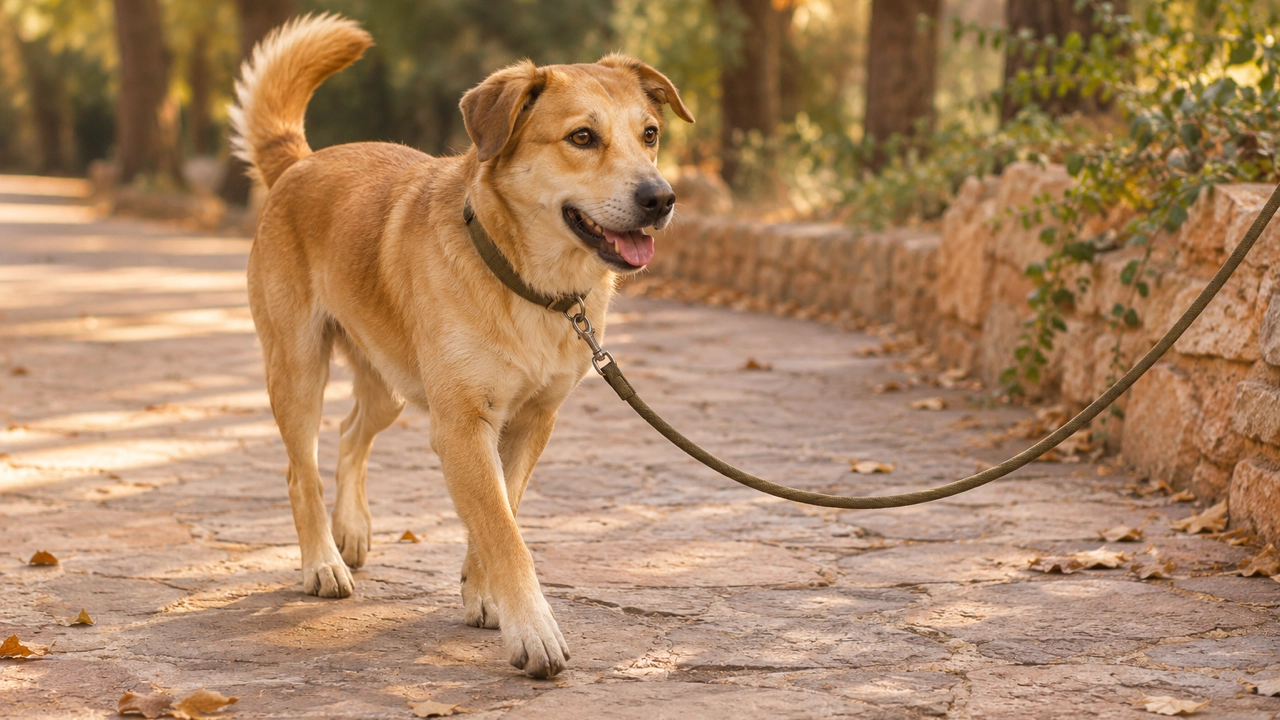
A standard fixed lead. A lead of roughly six feet is the baseline the AKC recommends for sidewalks, crowds and anywhere you need your dog near you. Its length is always obvious, and so is the signal it gives your dog. Look at the practical details: a handle that is comfortable to grip, hardware that opens and closes smoothly, and material you can hold firmly in wet weather.
A long line for planned freedom. If what you want is room to roam, a light fixed-length long line in a safe, open space gives that range without a spring. It has no brake to fail and no retraction to mislead the dog, though it needs careful handling so it does not tangle or run through your hands.
Training to make the standard lead enough. Many people reach for a retractable lead because pulling makes the fixed lead feel like a battle. Rewarding your dog for staying near you, and stopping when the line goes tight, tends to solve more than any piece of equipment.
A fair verdict
A retractable lead is a specialist tool that is often sold as a general one. In an open, quiet place, for a dog who already walks well, it can be a pleasant way to give them space. On a pavement, in a crowd or with a dog who pulls, it works against you.
If you own one, keep it for the places it suits and keep a fixed lead by the door for everything else. If you are choosing your first lead, start with the fixed one. You can always add the other later, once you know what your walks actually need.