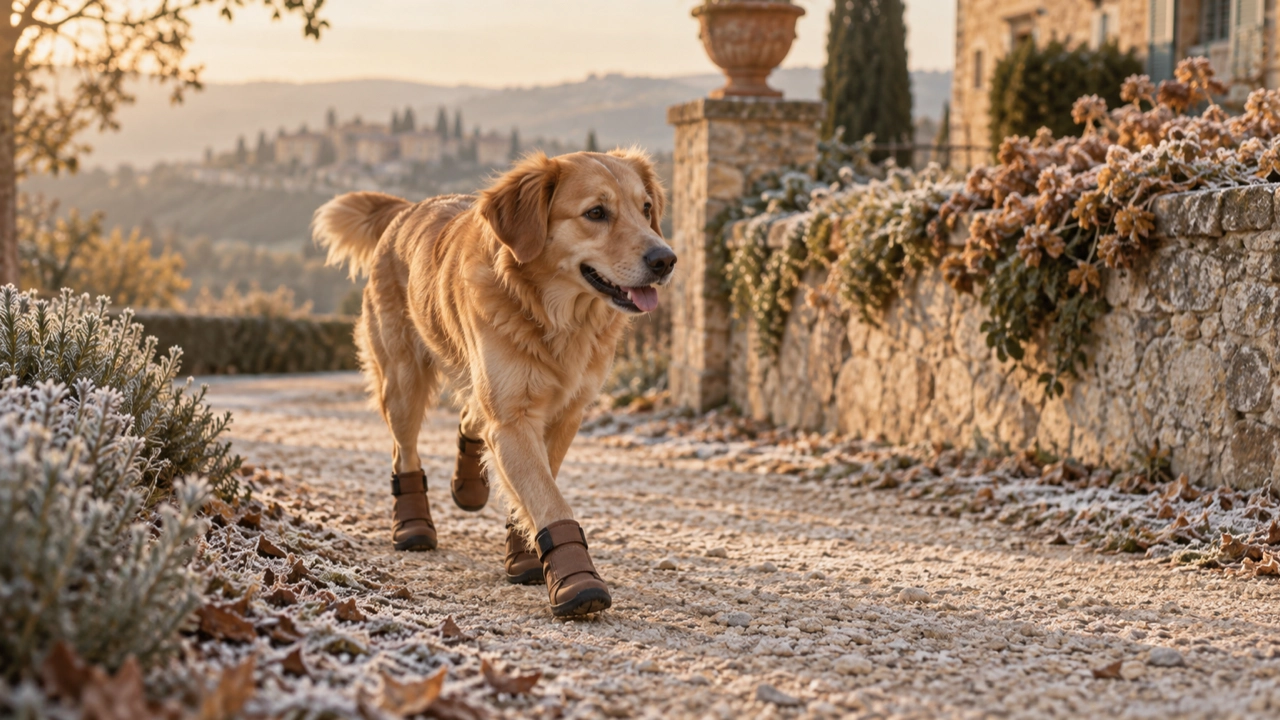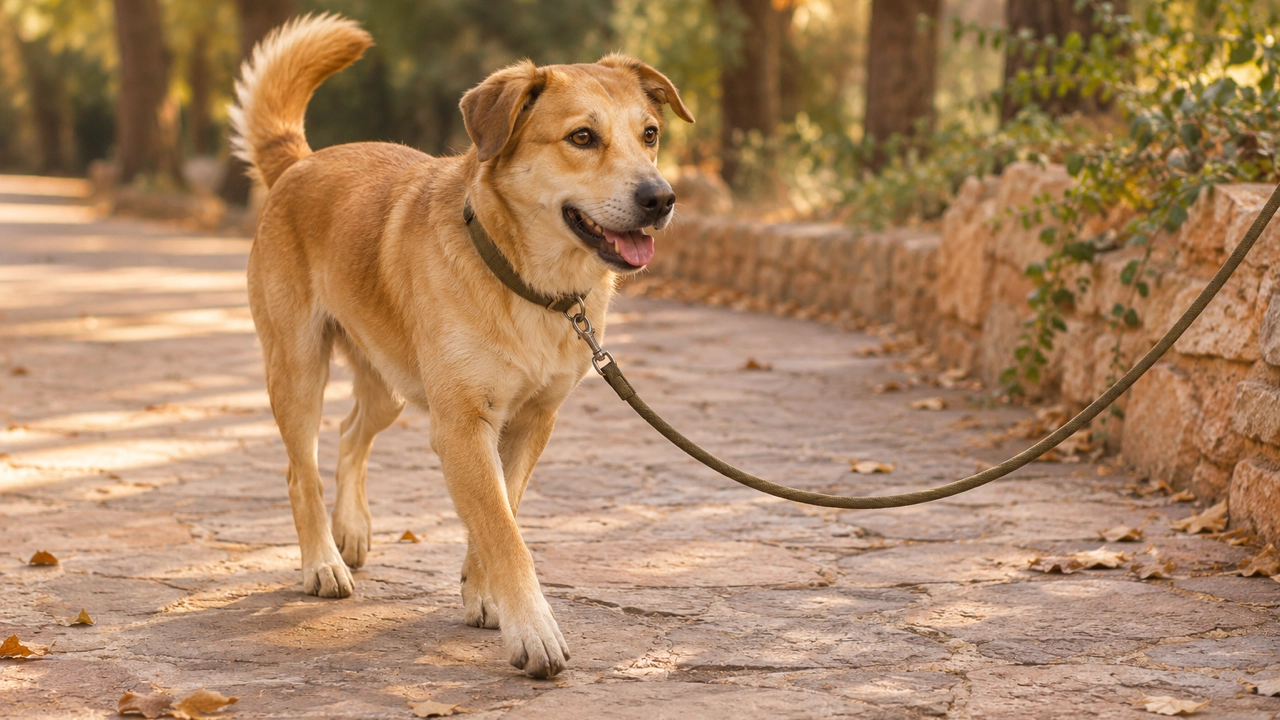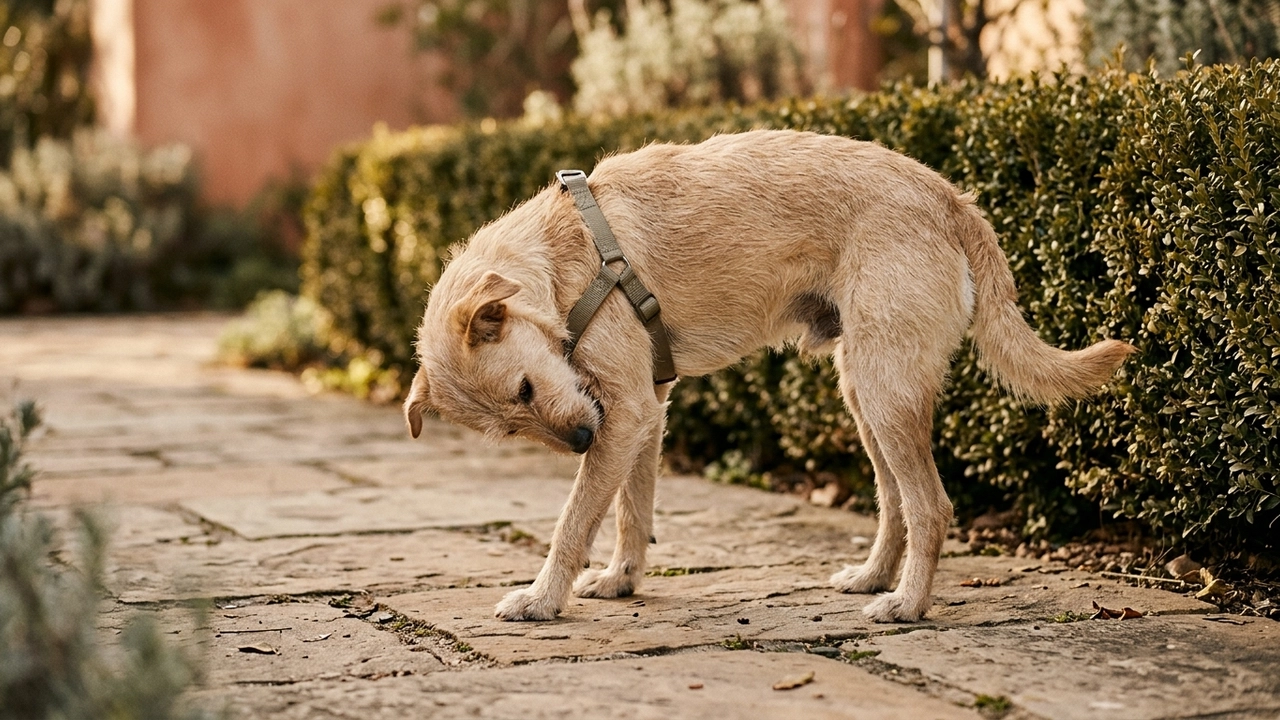
The harness fitted properly. Straps where the guide said, clearance right, first walks without a mark. Then a longer walk, and a pink line behind the front leg.
It is tempting to loosen something. Most of the time the strap is not too tight. It is in the wrong place, and it is moving.
A rub needs pressure and travel
Two things wear skin: how hard something presses, and how far it moves. A tight strap that stays still leaves a pressure mark that fades. A strap with a comfortable gap that slides back and forth all afternoon leaves the skin raw.
That second kind is the common harness rub, which is why the two-finger check can pass while the dog comes home pink. The check measures clearance, not movement. Behind the front leg the margin is small: thin skin over the ribcage and the moving shoulder, with the leg passing against the same strap every stride.
Why the strap ends up in the crease
A strap around a dog’s chest is a loop around a cone. The chest is widest behind the shoulders and narrows towards the neck, so a loop under tension travels towards the narrower end. A harness that fits by the front door has crept backwards by the end of the street.
Lead tension adds rotation. A lead attached at one point on the back pulls forward and twists, so each time your dog leans ahead the harness turns a little, then settles back. A centimetre each way, across the armpit, for the length of the walk. The strap is not rubbing because it is rough. It is sawing.
A dog who pulls steadily repeats that every stride, so the rub often appears first on the lead side. Our guide to why dogs pull on the lead covers the training.
Where it shows up
Behind the front leg. The classic armpit rub, and the one most often about movement rather than pressure. The strap crosses the crease, the leg swings through it, and the skin loses.
The point of shoulder. In front of the shoulder, where the front strap crosses the bony point. Less travel here, so a rub in this spot is usually pressure: a strap pulled straight across a curved chest.
The chest strap edge. On a deep-chested dog, a strap can bridge the breastbone instead of lying on it, and the edge takes the load.
The edge is what touches
The face of a strap is soft. The edge is not. Woven webbing has a hard bound edge, and the binding tape folded over it makes a seam thicker and stiffer than the strap.
Where that edge lands in the armpit crease, it works like a narrow blade. The same goes for bar-tack stitching, a label end, or the plastic rim of a buckle under the leg.
Two harnesses with identical padding behave differently depending on where the seam falls. A bound or rolled edge spreads the line into a band. It helps, but it does not stop travel.
Stiff webbing keeps its own line
Stiff webbing holds its shape instead of following the body. On a curved chest it touches at the highest points and bridges the rest, so pressure concentrates. It also passes movement along: every swing of the leg arrives at the strap.
New webbing is stiffest, so the first weeks are often the worst. Very soft webbing folds under load, and a folded strap is a hard ridge. The useful middle holds its length but flexes across its width.
Padding that traps heat
Padding is the obvious response and often the wrong one. A few millimetres under the strap moves the contact line, sometimes deeper into the crease you were trying to clear. Closed-cell foam and neoprene do not breathe, so the armpit stays warm and damp. And a sleeve that is not stitched down slides and bunches as the harness rotates, adding a second moving layer.
Padding earns its place when the problem is pressure over a bony point and the strap stays put. It does not fix movement.
Grit, salt and sand
Friction needs something harder than skin. Grit, sand, road salt and seed husks qualify, and damp webbing collects them.
A winter pavement is the worst case. Salt dries into the fibres and the inside face of the strap becomes a file the dog carries home. Rinse it, dry it flat, and take the harness off between walks rather than leaving it on a damp dog.
Fit changes you did not make
Coat, weight and muscle all change the circumference the harness sits on.
A summer coat is thinner, so a harness that sat well over a full coat now sits closer to the skin. A senior dog loses muscle over the shoulders, which changes where the straps hang. A young dog fills out across the chest.
The dog changed and the fit did not. If the harness that worked last winter rubs this June, check position before deciding it is worn out.
If you are starting from the beginning, our guide to how a dog harness should fit covers measuring and adjusting. This is the next question: what to do when the numbers are right and the rub is not.
The details that actually prevent it
A front strap that follows the shoulder. A straight strap crosses the crease at the worst angle. A contoured strap curves behind the shoulder, and an offset or Y-shaped front moves the crossing point forward, away from the leg’s travel.
Attachment points that spread the tension. One ring in the middle of the back gives the lead a lever. A wider base, a second attachment or a front clip changes where the pull goes.
Seams and hardware away from the crease. No buckle, slider, label or bar tack where the leg passes. Hardware is the least comfortable part of any harness.
Panels on the flat of the chest. Broad, breathable panels spread load well, provided they sit on the flat of the chest rather than wedging into the fold.
Webbing matched to the dog. Heavy webbing on a small dog stays stiff. Thin webbing on a large dog folds under load. Both are a mismatch.
A diagnostic you can run in one walk
Walk your normal route at your normal pace. A rub found on a test walk is not the rub you have.
Film a minute from the side. Watch the strap, not the dog: does it drop or shift when the lead tightens, and does it come back?
Inspect the inside of the strap. A polished or fuzzy patch marks where the webbing has been moving.
Mark the strap, not the dog. A strip of tape at the contact point, checked before and after, shows how far it moved.
Check the dog at home, then the next morning. A rub can be faint at the door and a clear line by breakfast. Photograph it with the harness on and off, plus a side view of the harness in place.
Then change one thing and repeat the walk. If the strap can be moved out of the crease without spoiling the fit elsewhere, you have your answer. If not, the shape is wrong.
When to stop using it
Take the harness off and use something else if you find broken skin, an open or weeping patch, swelling, heat, a smell, or hair loss over broken skin. The same applies if your dog flinches when you touch the area, licks at it, or moves differently on that leg.
Speak to your vet if the skin is broken, the area is spreading or not improving after a couple of days, there is discharge, or your dog seems lame or in pain.
A rub that returns to the same spot after it heals is telling you something padding cannot. That harness does not suit your dog’s shape, whatever the size label says.
The harness is doing what its shape tells it to do
Most harness rubs are not a padding failure or a sizing failure. They are geometry: a strap travelling across a thin, folded piece of skin that was never designed to take it.
Fix the travel and the rub usually goes. The dog will tell you which one you did, about a mile into the next walk.