There is no useful universal number for a senior dog’s exercise. Two dogs of the same age can have very different days: one still sets off with purpose, while another needs time to find an easy rhythm. Breed, size, previous activity, weight, mobility and any health condition all matter.
That does not mean movement should quietly disappear from the routine. Most older dogs still benefit from regular, gentle activity and the chance to explore. The better question is not how many minutes an older dog should walk. It is how to build a routine they can enjoy comfortably, then adjust it when their body gives you new information.
Start with the dog in front of you
Age alone does not make a dog senior on the same day for every breed. Larger dogs often show age-related changes earlier than smaller ones, and a lively older dog is not necessarily ready for the same outing they managed a few years ago.
Begin with a clear view of the current routine. Notice how your dog rises after resting, moves in the first few minutes outside, handles a gentle slope and settles when they come home. Also notice what happens later that day and the following morning. A walk that looks manageable at the time may have been too much if your dog is noticeably stiffer, slower to get up or reluctant when the lead appears next time.
If your dog has a diagnosed condition, has been inactive for a while or is showing a new change in movement, speak with your veterinarian before making a substantial change. They can help distinguish normal slowing from pain or another issue that needs a more specific plan.
Choose consistency over a heroic walk
For many older dogs, several calm opportunities to move are more useful than one ambitious outing. A short walk before breakfast, a gentle sniff outside later in the day and a quiet evening loop can be easier to recover from than saving all activity for a long weekend route.
Keep the starting point modest. If your dog has been comfortable with a familiar ten-minute route, there is no need to turn it into a fitness project. Let them establish a steady pace, then add a little time or distance only when they are recovering well. Change one thing at a time, so it is easier to understand what helped and what did not.
Regular movement is not only about covering ground. An unhurried walk lets a dog take in changing scents, surfaces and sounds. That exploratory side matters too. Our guide to why dogs stop and sniff on walks is a useful reminder that a slower outing can still be a rich one.
Let the route do some of the work
The same distance can feel entirely different depending on where it happens. Favour flat, even, familiar surfaces when you are working out what your dog handles well. A smooth path or short stretch of grass can be more forgiving than loose stones, steep hills or slippery paving.
Think about the practical details around the route as well. In hot weather, choose cooler times and carry water. In rain, a shorter route with good footing may be the more comfortable choice. If vision or hearing is changing, quiet places with fewer surprises can make an outing feel steadier.
This is not a reason to make every walk identical. Variety is valuable when it remains within your dog’s comfort. A different park bench to pause beside or a new, level path can offer novelty without turning the day into an endurance test.
Use the pace your dog offers
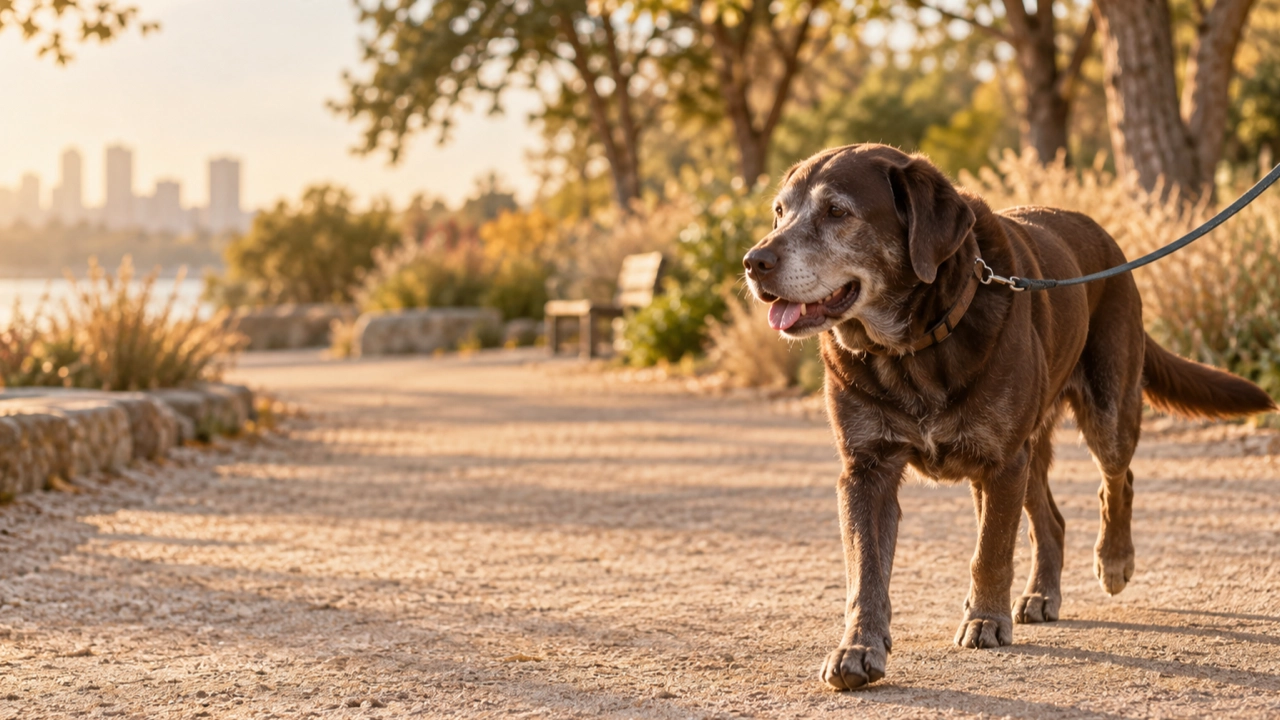
An older dog does not need to keep up with an old version of themselves. Keep the lead loose where it is safe, allow time to stop and avoid repeatedly asking them to hurry through a moment of hesitation. Slowing down can be ordinary preference, but it can also be useful information.
Watch for a change from your dog’s usual way of moving: lagging behind, repeatedly stopping, a shortened stride, difficulty turning, reluctance to jump into the car or a new reluctance around stairs. Heavy panting in mild conditions, weakness, limping or a refusal to put weight on a leg deserve prompt veterinary advice rather than a push to finish the route.
It can help to keep a simple note for a week or two. Record where you went, roughly how long you were out and how your dog seemed afterwards. Patterns are easier to see on paper than from one tired evening. That record is also useful to take to a veterinary appointment if you are concerned.
Keep play gentle and purposeful
Exercise does not have to mean a formal walk. Some dogs still enjoy a short game of tug, a few easy retrieves on a non-slip surface or gentle searching games around the home. Others prefer a slow wander in the garden with you nearby.
Make the activity fit the dog rather than the idea of an active senior. Repeated sharp turns, high jumps and sudden sprints may not be comfortable for every older body. There is no need to test a dog’s limits to give them an interesting day.
Mental activity is a useful companion to physical movement, especially on days when the weather or mobility calls for a shorter outing. Scatter a portion of a meal for a supervised search, hide a few treats in an easy room or revisit familiar cues in short, successful sessions. These are not replacements for all physical movement, but they can make the routine feel fuller without demanding more from joints and muscles.
Consider the day after, not just the walk itself
The best measure of a routine is how it holds up over time. A dog may be pleasantly tired after a gentle outing, then return to their normal self after a rest. A more concerning pattern is soreness that lingers, unusual sleeping, a slower start the next day or reluctance to repeat an activity they normally enjoy.
When that happens, reduce the last change you made. Shorten the route, choose flatter ground or add more rest between activities. Avoid making several changes at once. If the signs continue, ask your veterinarian for guidance instead of assuming that age is the full explanation.
Dogs with arthritis, heart or respiratory conditions, recent injuries or significant weight changes need an individual plan. General advice cannot tell you what is safe for a particular dog. The RSPCA similarly notes that older dogs still need regular exercise, often in shorter walks, and that stiffness or trouble getting up should be discussed with a vet. A realistic daily activity routine can also help frame movement as a habit rather than a single target to chase.
Make the routine easy to keep
Small practical choices make gentle movement more likely to happen every day. Keep the lead by the door. Choose a route that does not require a car. Leave enough time for sniffing instead of trying to fit a walk into the narrowest gap in the day.
As your dog ages, care often becomes less about doing more and more about paying closer attention. A shorter, comfortable walk that your dog looks forward to is more valuable than an impressive route that leaves them depleted. Build from their usual rhythm, stay curious about changes and let veterinary advice guide the moments that feel uncertain.
Join the Ottimo Plus waitlist for considered dog essentials designed around everyday life together.