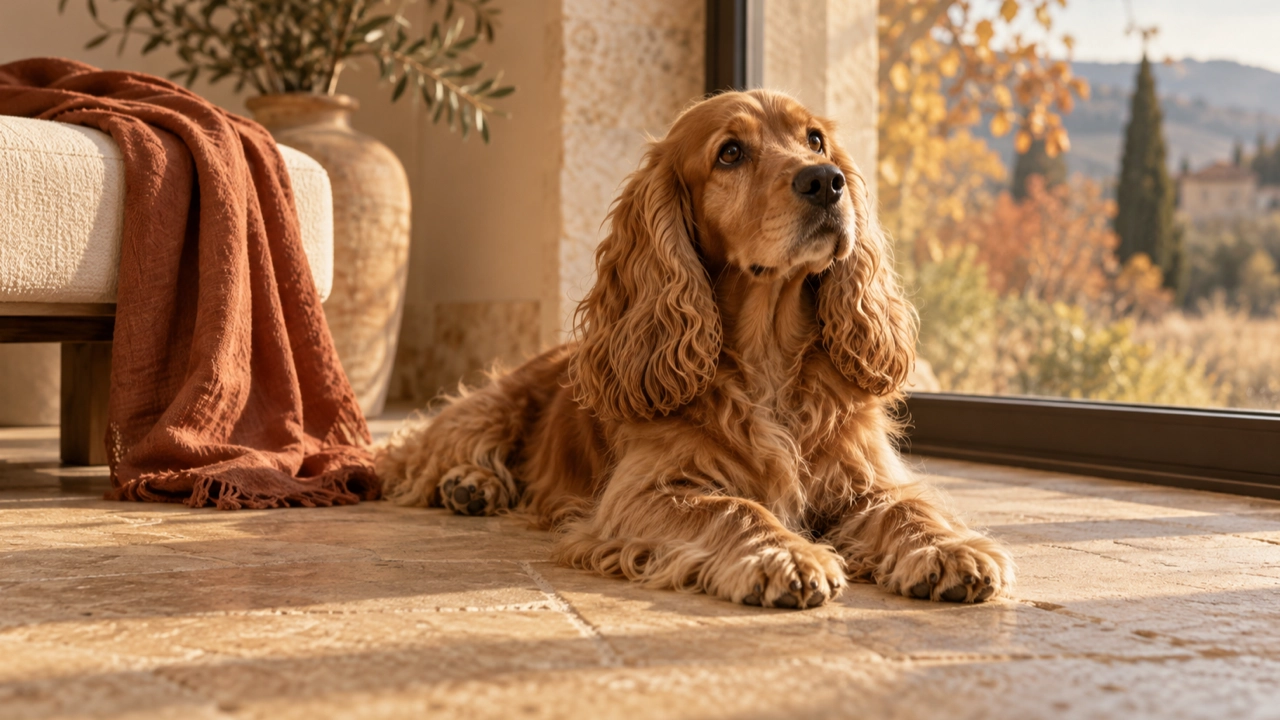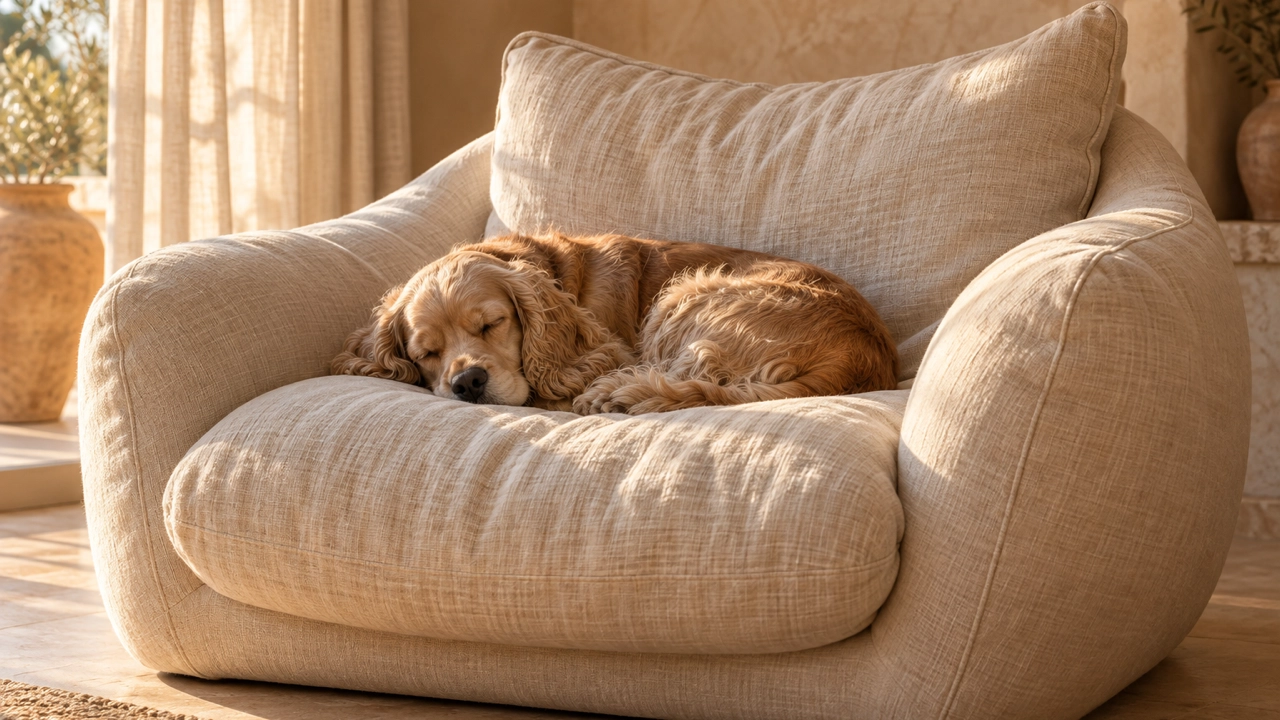
The heating has been on since six. The windows are shut, and your dog is curled into a tight ball with their nose tucked under their tail. It is fair to ask whether the house is warm enough for them.
Most of the time it is. But a warm room and a warm dog are two different measurements, and the gap between them usually comes down to the floor.
Do dogs get cold at night indoors? Some do, and often the same dogs each winter. A heated home removes the weather but not the variables: coat, size, body condition, age, health and where the bed sits. For the outdoor half of the question, our guide to how cold is too cold to walk a dog covers the walk.
The floor is not the temperature you feel
The thermostat is set at shoulder height, where people are. Warm air rises, so the air a dog sleeps in is cooler than the number on the hallway panel. Floors near windows and outside doors run cooler again, and tile, stone and bare boards hold a chill that carpet does not.
A thick-coated dog on a good bed in a living room is fine. A thin-coated dog asleep on a tiled floor beside a back door is not, and that is where many dogs choose to sleep.
A thermometer on the floor next to the bed tells you more than the wall unit does.
Which dogs feel it more
Cold tolerance is not a single setting.
Coat. A dense double coat traps warm air close to the skin. A short, fine or single coat offers much less. Hairless breeds, recently clipped dogs and dogs with thinning fur on the flanks feel the cold sooner.
Size. Small dogs have more skin surface relative to the body mass that generates heat, so they lose warmth faster and replace it more slowly.
Body condition. A very lean dog has less of the insulating layer beneath the skin. Extra weight is not a sensible way to keep a dog warm, though. If your dog carries more than suits them, that is its own project: walkingdog.io’s long-term overweight plan is a sensible place to start.
Age. Puppies lose heat quickly and cannot always move somewhere warmer. Senior dogs lose muscle and shift stiff joints more slowly, so a draught bothers them before it bothers anyone else.
Health and grooming. Arthritis, thyroid problems, kidney or heart conditions and some medications all change how well a dog holds warmth. So does a groom that took off more coat than you expected.
If your dog has a condition affecting circulation, hormone levels or mobility, ask your vet a direct question: does this dog need a warmer setup than a healthy adult would?
Signs a dog is cold at night
A dog in a genuinely cold bed rarely hides it. Look for a combination of signals.
- Curling tighter than usual, nose tucked towards the tail
- Burrowing under bedding, or pressing into cushions and walls
- Shivering while resting, not only after a walk
- Restlessness: settling, getting up, circling, settling again
- Ears, flanks or paws that feel cool compared with their normal
- Reluctance to get up, or stiffness that eases once they move
Then there is the opposite error. A dog who pants on the bed, pushes the bedding aside or stretches out on a cool floor is usually too warm. Overheating at night is easy to miss, especially with a thick coat in a well-insulated bedroom.
Burrowing alone is not proof of cold. Dogs dig into bedding because it feels sheltered. If your dog settles quickly and wakes up loose and comfortable, the arrangement is working.
Why blankets often fail
A blanket is the first thing most people reach for, and often the least effective.
A blanket over a cold floor is still a cold bed. Insulation below the dog matters as much as insulation above. A thin layer on tile does almost nothing.
Loose bedding slides. Dogs circle before they lie down, so an unattached blanket ends up against the wall within a minute.
Filling compresses. The warmth in a bed comes from trapped air. Cheap filling flattens under a large dog and stops trapping anything.
Some dogs cannot use a cover. A dog with arthritis may not manage to burrow. A puppy may chew a loose blanket. A dog who fights fabric will not settle.
A cold dog cannot warm a cold blanket. Bedding should hold the warmth a dog brings, not make the dog heat the bed.
What actually helps
Start with the bed, then the room, then the dog. In that order, the changes are cheap and they work.
Fix what is under the dog. A bed with a firm base and a dense, shape-holding cushion lifts the dog off cold boards. On tile, a rug under the bed is insulation, not decoration.
Move the bed before buying anything. A corner away from outside doors and single-glazed windows is warmer than the open middle of a room. Avoid the strip against a radiator, which swings between too hot and cold.
Layer with a purpose. A base the dog sinks into plus a top layer they can burrow under gives them a choice. For a small or thin-coated dog, a covered bed traps warmth far better than an open cushion.
Warm the bed, not the house. Warm it before your dog gets in, with a pad designed for pets or a hot water bottle removed before they settle. Never leave either where a dog can chew it, or with a dog who cannot move away.
Dry the coat before bed. A damp coat loses insulation, and a late walk in drizzle is enough to spoil a warm bed. Towel the belly, legs and chest, not just the back.
Consider a fitted indoor layer. A close-fitting fleece suits some thin-coated dogs, particularly older ones with sore joints. It must be dry and free of rubbing.
Keep the night temperature steady. A house that drops sharply at midnight is harder on a vulnerable dog than one that stays even. If your dog is very young, very old or unwell, do not shut the heating off entirely in the room where they sleep.
Use company as insulation. Some dogs settle better when they can hear the household. Our guide to whether your dog should sleep in your bed weighs that honestly.
What to avoid
Electric blankets and human heating pads. Dogs cannot judge the heat, cannot always move away, and can chew a cable.
Heat lamps and open fires. A dog can settle too close and overheat, or burn skin that is thin with age.
A coat left on all night. Indoor layers twist, rub or trap damp. Take it off once the dog is settled.
Raising the whole house temperature. A thick-coated dog in a heated bedroom is more likely to overheat than to catch cold. Adjust the dog’s setup, not the building.
When the cold is a health question
A chilly dog settles once the bed is better. A dog whose body is struggling to hold warmth is a different matter.
Speak to your vet if your dog shivers in a warm room and does not stop, seems weak, wobbly, confused or slow to respond, or has gums that look pale or bluish. The same applies to new stiffness in the morning, night restlessness lasting more than a few nights, unexplained weight loss, or changes in drinking and toileting.
True hypothermia indoors is uncommon, though not impossible in a very old, very thin or unwell dog in a cold house. It is not something to wait out. Cold also makes stiff joints stiffer, so a dog who is worse on winter mornings may be telling you about pain rather than temperature. Our guide to how much exercise a senior dog needs covers keeping an older dog mobile through winter.
The house and the dog
Most dogs sleep through the night in an ordinary house without help. The ones who do not are telling you something specific: the floor is cold, the bed has gone flat, the draught reaches the corner they chose, or their coat is thinner than last winter.
None of that needs a warmer house. It needs a better bed in a better spot, and a look at the dog rather than the thermostat.