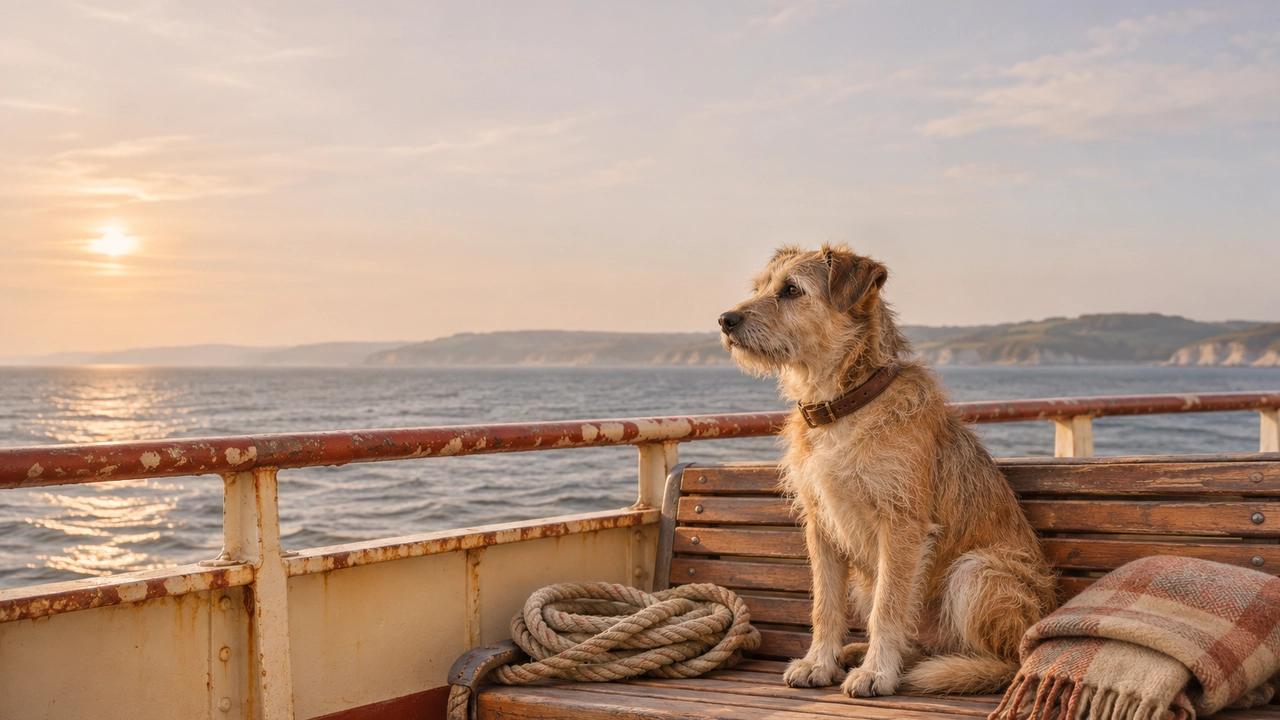
A ferry is one of the calmer ways to cross water with a dog. No crate dimensions, no cargo hold, no airport queue. What it does have is a booking decision most owners do not realise they are making.
Can you take a dog on a ferry? Usually, yes. Ferry companies that carry cars generally take dogs on some routes, under conditions they set themselves. The question worth asking is not whether dogs are allowed, but where your dog will spend the crossing.
The rules belong to the route, not the country
There is no single ferry rule for dogs. Two companies on the same stretch of water can ask different things, and one company can apply different conditions on two of its own ships. Route length, the age of the vessel, whether the crossing is overnight, and the country at the other end all change what applies.
Ask the operator about your sailing by email, so the answer is in writing. Policies are revised, and a page written for last summer may not describe this one.
Three places your dog can spend the crossing
On most ships the choice comes down to three arrangements, and not every route offers a choice.
A pet-friendly cabin. The best version of the crossing, where it exists. These are a small share of the cabins and usually the first to sell out, so ask when you book. Ask, too, whether the dog may be left alone in the cabin while you eat. The answer is not the same on every ship.
An onboard kennel. A block of kennels, often near a vehicle deck or in a dedicated space. The kennel is small, and you may or may not be able to visit during the crossing. Ask how many the ship has, and whether water is provided. Bring bedding that smells of home, a bowl and a label with your mobile number.
The car. The most common arrangement on short crossings, and the one that gives you least control. The dog stays in the vehicle for the whole voyage, and you do not.
Why the vehicle deck stays closed
Once the ship is loaded, the vehicle deck is usually closed to passengers and stays that way until it is ready to unload. You walk up with everyone else, and you do not go back down.
The reasons are practical. A vehicle deck is a working space of ramps, stanchions, mooring equipment and cars parked close together, with no safe route for people to move through it at sea. The effect is simple: you cannot look in on the dog twenty minutes after sailing.
That should shape the booking. A dog in the car is a dog you will not see for the length of the crossing, so the car has to be somewhere they can reasonably spend that time. Some operators refuse animals in vehicles on longer routes and require a kennel; others allow it for a short hop and refuse it overnight.
Heat and air on a long sailing
The vehicle deck is often the warmest part of the ship: steel, engines, parked cars, limited airflow, and the sun on the hull. On a two-hour crossing in April this hardly matters. On a six-hour crossing in July it is the main risk.
Ask which deck the car will be on, and whether it is covered and ventilated. A straight answer tells you more than the pet page does. If nobody can tell you, assume the least favourable version.
Choose the sailing with the weather in mind; an early or overnight crossing is cooler in summer. Prepare the car as a place to rest, with the restraint your dog already knows, absorbent bedding, and water in a bowl that will not tip. A dog who arrives at the port already hot has nowhere to cool down on the deck.
If the forecast is extreme and the car is the only arrangement, change the sailing rather than the plan.
Muzzles, breeds and where dogs cannot go
A muzzle is a condition on some routes, and it is usually about the space rather than the dog: busy passenger areas, narrow stairwells, lifts, queues at the gangway. Some operators require one for every dog in those areas. Some apply conditions to particular breeds or types, and a few refuse certain dogs outright. None of this is uniform, and little of it is written plainly on the website.
If your route requires a muzzle, buy it early and get your dog used to it at home, in short sessions, with food. A muzzle fitted for the first time at a port gate is a poor introduction to a long day.
Ask where the dog may go on board. Food areas, restaurants and some carpeted lounges are commonly closed to dogs, and on many ships the permitted space is an open deck. Some vessels set aside a small area for dogs to relieve themselves. Find it before you sail.
Paperwork, and the order it goes in
Within one country, a ferry usually asks for very little: a dog that is booked, under control, and in the arrangement you reserved. Some operators still want to see a vaccination record at check-in.
Cross a border and the state rules apply on top of the operator’s: microchip, rabies vaccination, and the right certificate for your direction of travel. A small number of destinations also require tapeworm treatment, timed against your arrival rather than your departure. Our guide to taking a dog to Europe sets out that sequence and its waiting periods.
Documents are checked at the port rather than on the ship, so keep them with you rather than in the car. The return leg has its own requirements, which may not match the ones you left under.
The day itself
- Walk and toilet the dog somewhere quiet before the port, and offer water.
- Arrive with time to spare, but do not leave the dog in a stationary car in the sun.
- Keep the dog with you until a marshal sends you down to the deck.
- Settle the car as instructed: restraint, water, bedding, windows.
- Go up to the passenger areas and stay there.
- On arrival, wait to be called, and attach the lead before you open any door.
Boarding is where dogs get loose. Lead on before the door opens, every time.
What to ask when you book
- Is there a pet space left on this sailing, and is it a cabin, a kennel or the vehicle?
- How many of them does the ship have, and can I reserve one now?
- Can I visit the dog during the crossing, and at what times?
- Which deck will the car be on, and is it covered and ventilated?
- Does this route require a muzzle, or apply conditions to my dog’s breed or size?
- What documents will you check at the port, in each direction?
- When does pet check-in close, and where do I go?
After the crossing
The walk on arrival is not a training exercise. Water, shade, a short walk, and somewhere quiet to sleep. A dog who has spent six hours in a kennel or a car is tired in a way that more walking does not fix.
The crossing is one day. The weeks around it change more: different walks at different times, more time in the car, a routine that is not the one at home. Before a long trip, it is worth thinking about the daily pattern. If you are unsure how much walking those days should hold, whether one walk a day is enough sets out the arithmetic more plainly than most holiday plans do.
Book the arrangement, not just the ticket. A dog in a cabin, a dog in a kennel and a dog in a car are three different crossings, and only one will suit your dog.